
In retrospect, the fake books should have tipped me off.
When we moved into our first apartment in Taipei, Lawrence discovered to his delight that it came with fake books. There were a couple of white hardbound volumes, one that purported to be something called The Revolution by Ernesto Guevara and featured the classic image of Che in his star beret. Open it up, though, and on the first page what you found was a listicle with photos of different kinds of hanging lights and the heading “Meet the Highlights: The latest pendant lights are unabashedly ornamental. Adorn your home with our edit of the best from our 12 favorite brands.” Che, as far as I know, did not flog home décor in his writings. The content of the whole book was like that: random advertising copy printed on a couple hundred pages’ worth of cheap paper. And they didn’t even cobble together enough advertising copy to make all the pages different. The Highlights reappeared about every twelve pages to inaugurate a new cycle of the same material.


The other fake book, containing the exact same pages, was credited to “Barbera [sic] Barey.” You can find it sold online for an astonishing 25 Canadian dollars (about $18 US): https://www.thecandlecompany.ca/products/single-decorative-book-20. I mean, you could buy a real book for that, a book that someone spent years of their life researching and writing! This book, for instance–only $18.20 in paperback: https://www.sup.org/books/title/?id=25648.
When Lawrence saw the Che volume he said that it was like we were hiding revolutionary propaganda in our house, but the opposite: our communist manifesto was actually a front for bourgeois lifestyle tips. I’ve seen that kind of fake book once before, when we wandered through Restoration Hardware out of curiosity. Their fake rooms have lots of fake books of this same kind, white hardbound volumes with no content that purport to be about things that might appeal to rich people who want to seem cultured–art, architecture, design.
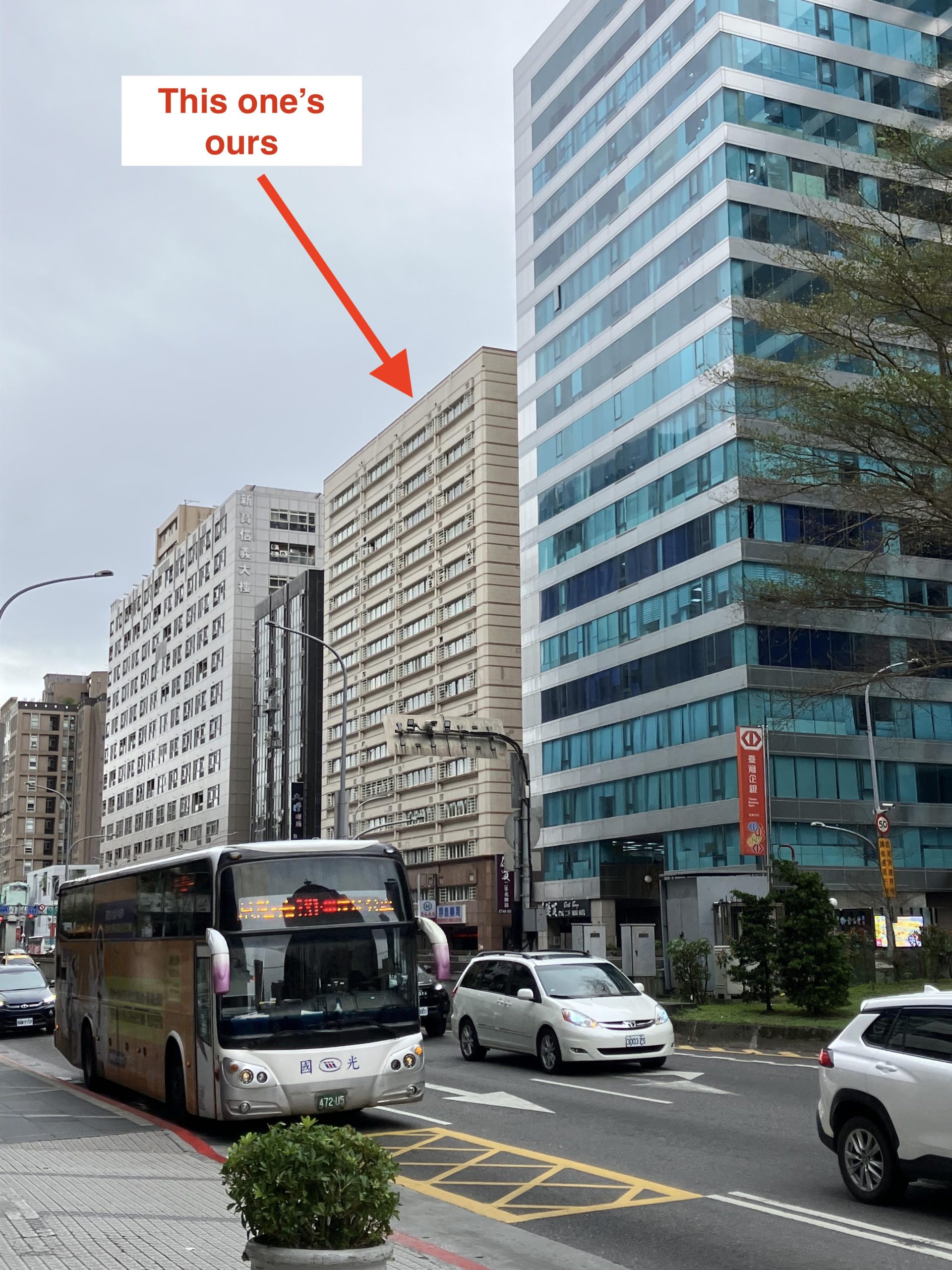
The apartment, it turned out, was also masquerading…as a posher place. Now, it definitely has posh aspects. We’re on the thirteenth floor of a fourteen-floor building, and our landlord is a large company that runs a business hotel on the second floor. That’s why they’re able to pretty easily equip our apartment hotel style. It came with all the things you might expect in a nice hotel: towels and sheets, a microwave, closets (not always present in Taiwanese apartments), small desks, a couch and a large TV, even a hair dryer. And it has the things you’d hope for in an apartment, as well: two induction burners, a refrigerator with a freezer, a washer-dryer, and air conditioning. As a bonus, the A/C machines also have a heating function that we’ve used a number of times–turns out Taipei does get a little chilly in the winter sometimes. The beds came with warm blankets, and the staff from the downstairs hotel even comes up every week or so and changes the linens and cleans the bathroom! It seems like they didn’t actually expect us to cook, because the place had no pots, pans, dishes or eating utensils. We were able to borrow two plates and bowls from the hotel, though, and pots and utensils were easy to buy cheaply.
So: on the surface, this looks like a fancy big-city apartment. From the thirteenth floor, it’s got pretty great views of the neighborhood. (warning: lots of photos below–this is my favorite thing about this apartment)


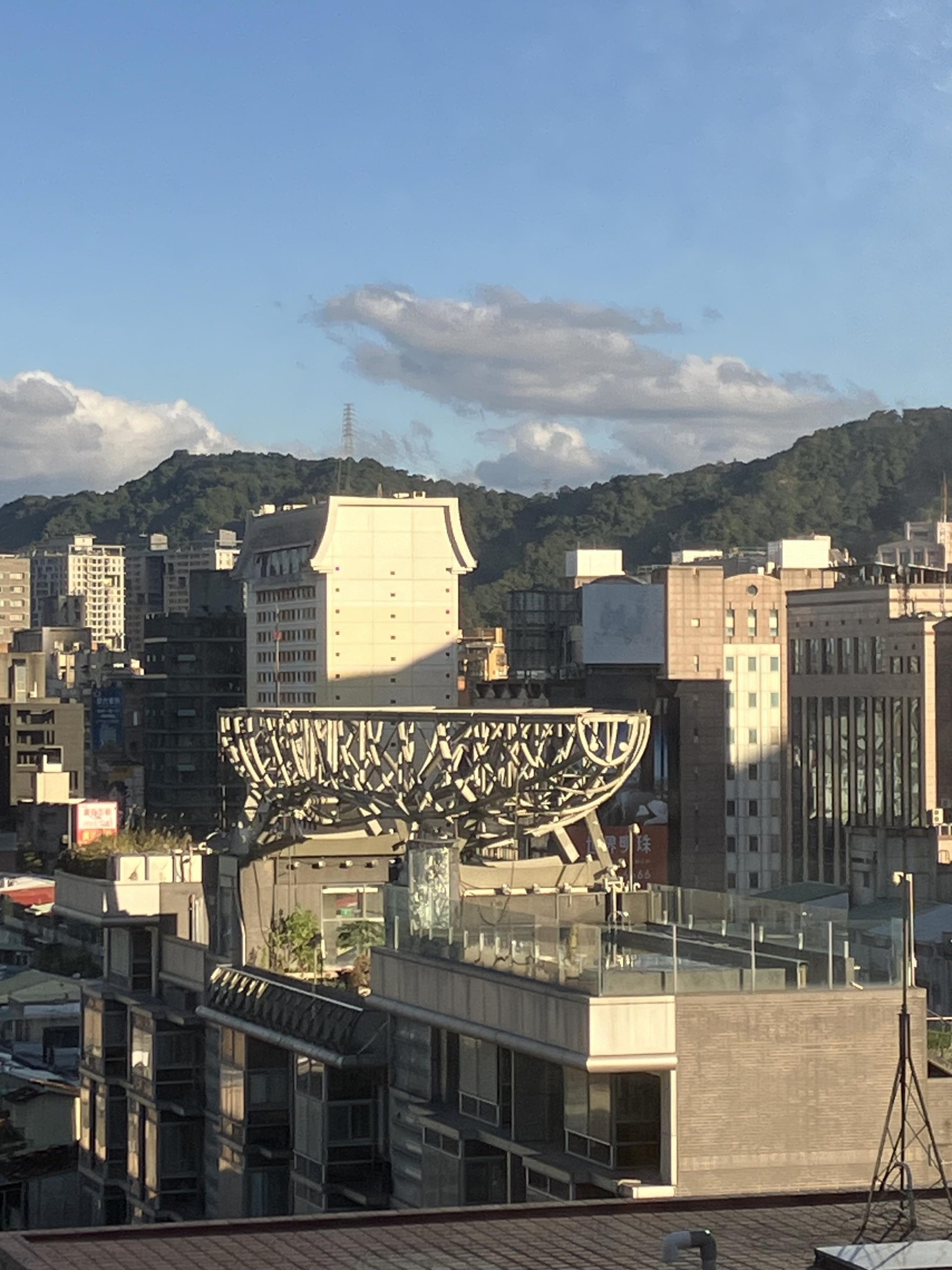
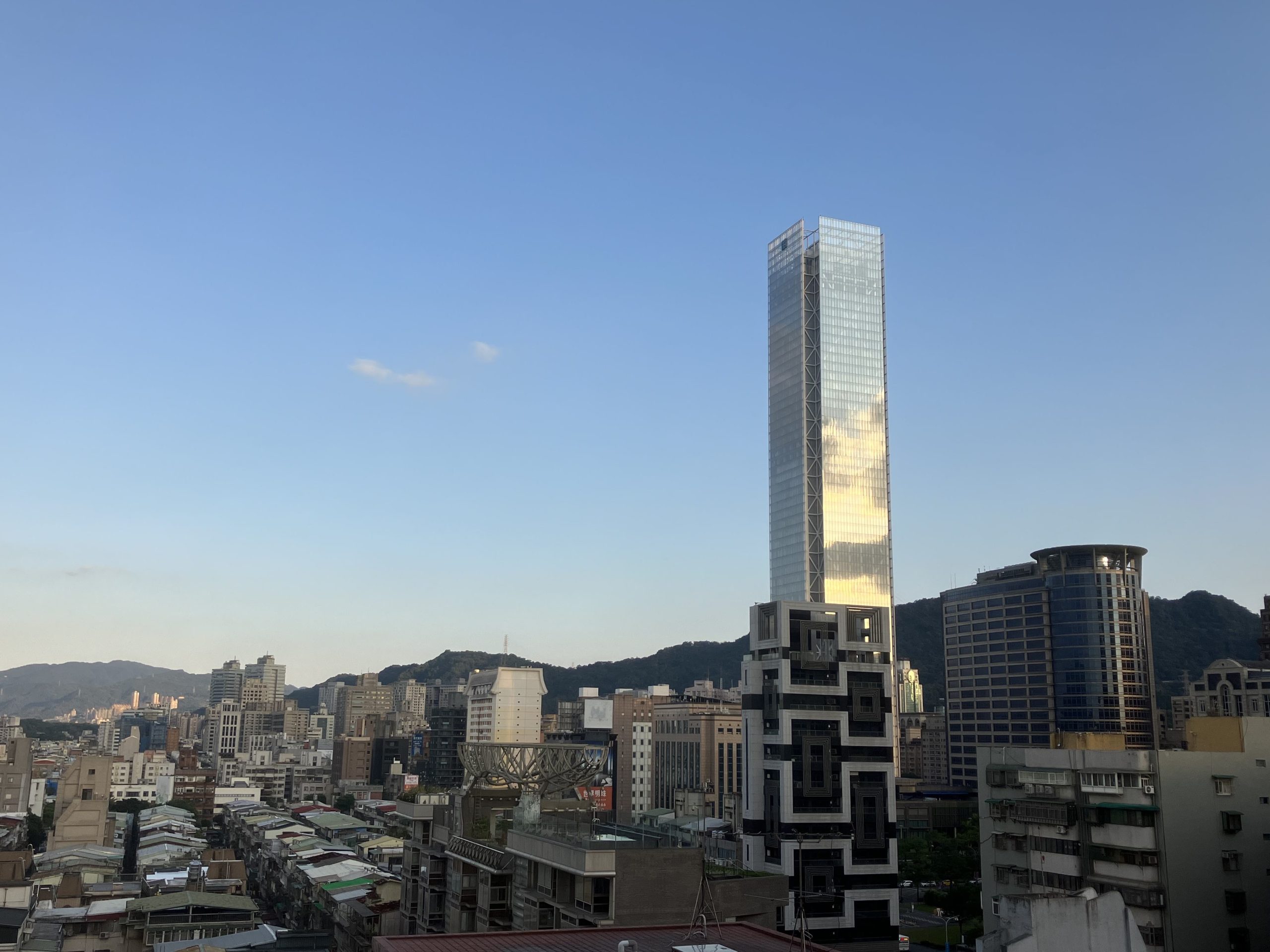
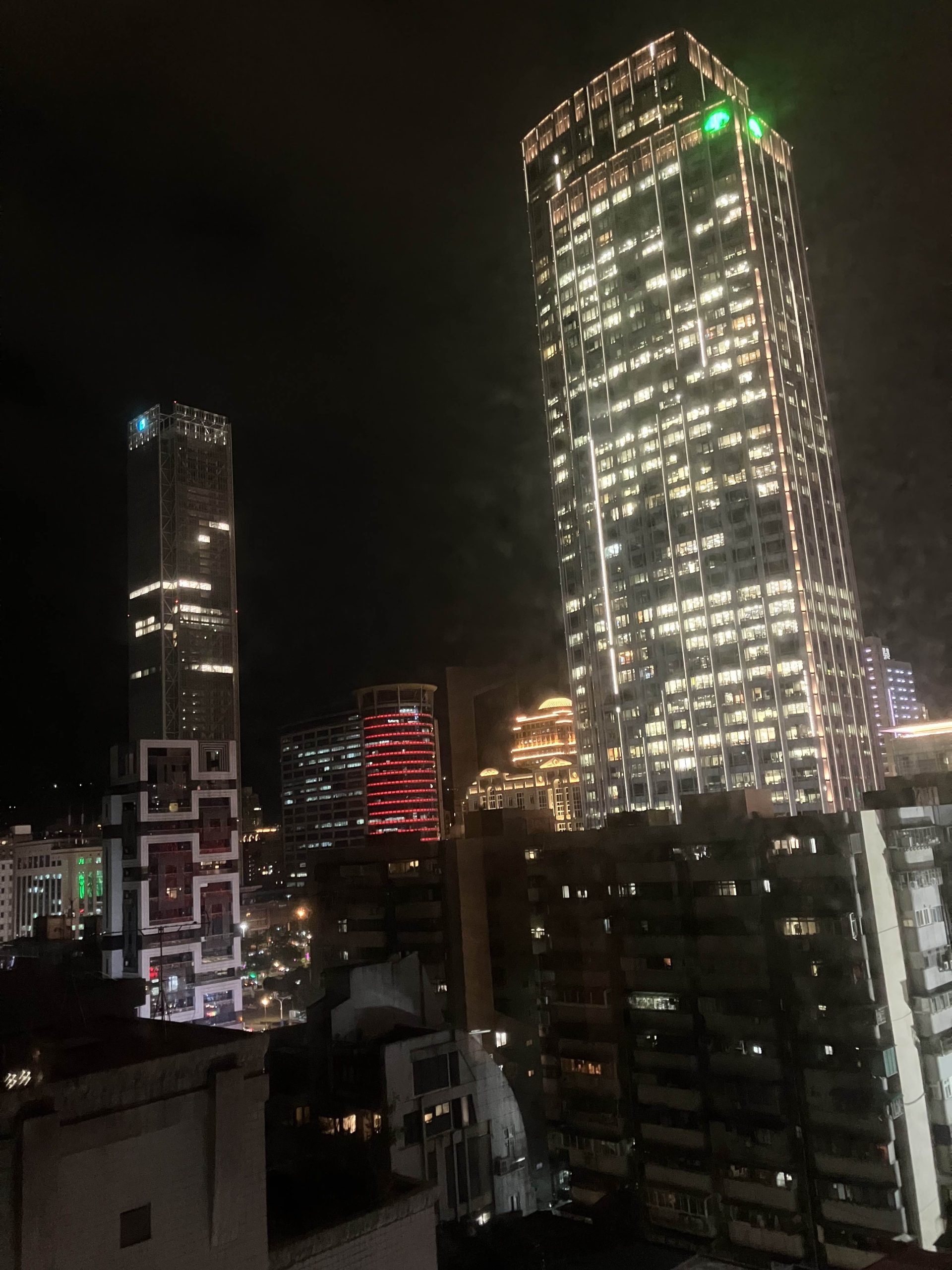
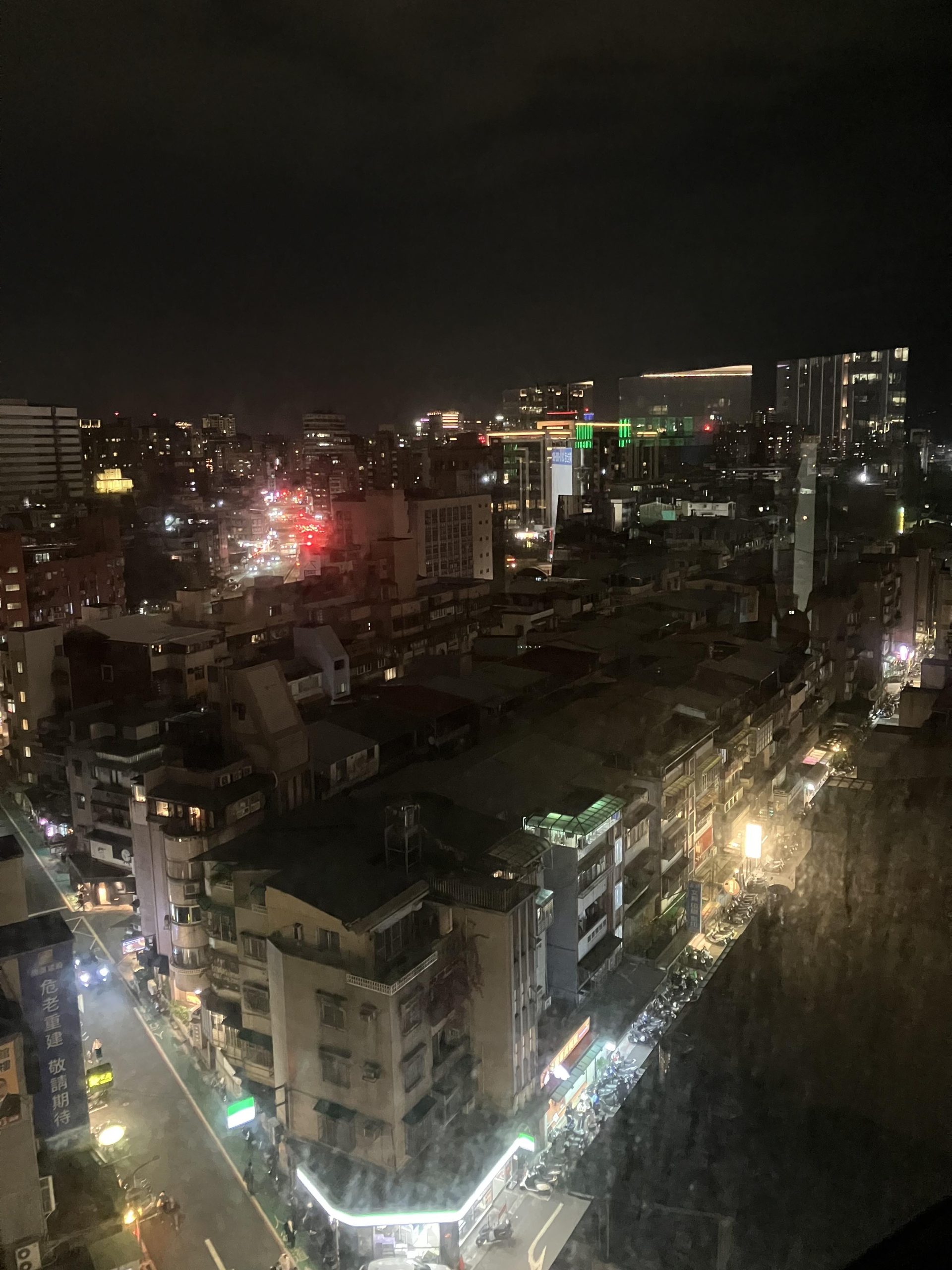
The décor gives off an industrial-loft kind of vibe, with high concrete ceilings and stark gray-and-white walls. In addition to the fake books, the place also came with fake plants (a couple of plastic cacti) and arty photos/prints of Manhattan. When colleagues glimpsed a bit of the place in the background of our Zoom meetings, they exclaimed, “Wow, your place looks nice!”
It looks, I think they meant, expensive–and that it certainly is. Somehow I ended up agreeing to pay 85,000 New Taiwan Dollars a month for this place, which comes out to $2708 US at current exchange rates.
Why did I agree to such a price? Friends, I’ve been asking myself the same question for weeks. Here are some of the explanations I’ve come up with. First of all, it wasn’t far out of line with what I have heard about people paying to rent luxury apartments in Denver over the past few years, and Taipei is a national capital and major East Asian hub, so it didn’t seem outrageous that rents might be as spendy or spendier here. Plus, the broker who served as the middleman for this apartment told me, when I first met him and told him my budget was 70,000 or less, “I don’t think you’ll find much under 70,000.” I have since learned to add a pinch of salt before swallowing what I hear from brokers. I had also heard from other Fulbrighters whose apartments cost even more than that, so I felt reassured that I wasn’t getting ripped off.
Also, when you’re working with a currency whose basic units are 30 times the ones you’re used to, it’s hard to contextualize what you’re spending. Fifty thousand or sixty thousand dollars a month is already a fantastical number to think of as rent, so eighty-five thousand is just another absurd figure. It is kind of fun to inform people back home that Taipei American School (TAS)’s tuition is ONE MILLION DOLLARS (NTD) per year.

But none of that accounts for how I let the figure slide persistently upward. First, after showing me the original apartment I’d been interested in, the broker showed me the apartment next door which was slightly bigger and had windows on two sides instead of just one. Wouldn’t I like this bigger one instead? Why, yes, I thought–remembering that Babi and Cora would come visit in June and we’d need more room then–I would like that one. Well, the original one could be had for 78,000/month (but wait: hadn’t the ad online said 69,000?), but this bigger, better one was 85,000/month. Okay, seems reasonable, I thought. In my defense, I’d been in the country for all of four or five days when these conversations were happening. Lawrence and I had been dealing with jet lag; figuring out how to get cell phone service and how to use LINE, the text/phone app that everyone in Taiwan uses; finding places to eat and relatedly, dealing with a case of food poisoning; learning to navigate the apartment-hunting app, which you can’t use properly until you have a Taiwanese phone number and LINE set up–see earlier item; and so forth. I was just relieved that we nailed down a place at all.
And then came the final upward nudge: the day we signed the contract and moved in, I said I needed a receipt for rent payments that I could submit to my grant funder as proof that I am using their money for rent (and not, say, gambling or booze). Oh, I wanted a receipt? Well, I’d need to pay an additional 5% to get an official receipt, because generating an official receipt triggers a report to the tax bureau and means the landlord will have to pay legally mandated tax on rentals (wait, the company that owns the place wasn’t going to pay its taxes? What? Apparently tax avoidance/evasion is pretty widespread in Taiwan, perhaps a topic for another post). At the time, after less than a week in this country and conducting all these discussions in Chinese, I didn’t feel up to arguing, so I agreed. Another NTD4250 was duly added to the monthly rent, bringing the total up to NTD89250, or $2975 US per month. Gulp.
Then it turned out that this pricey big-city apartment with its dazzling new appliances was really just a fancy white cover wrapped around a nonsensical core.
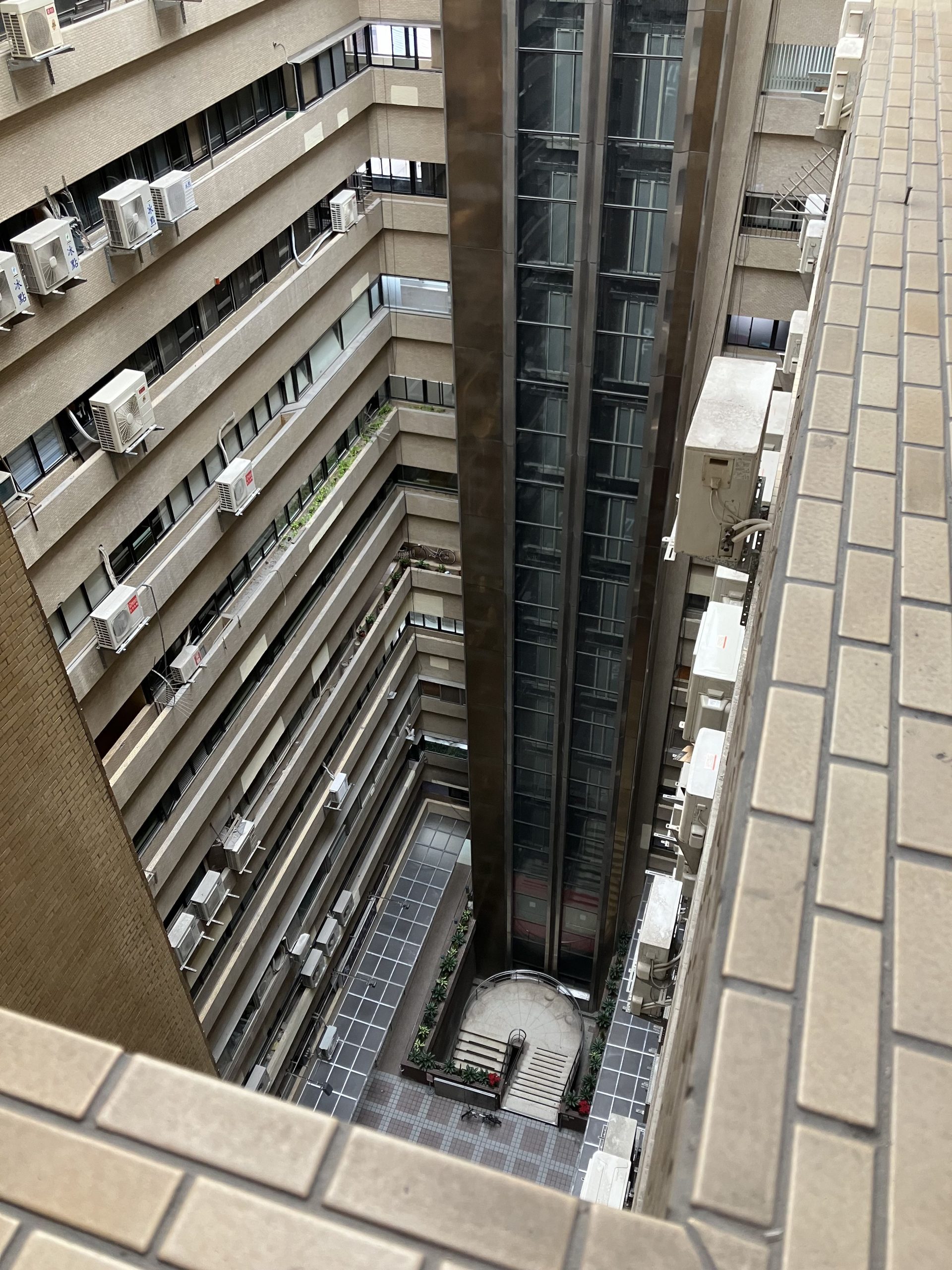
What’s nonsensical about this place? First of all, it’s not really a residential building. Well, not primarily a residential building. We live in one back corner of one floor, and for a while I thought we were the only people who lived here. As I mentioned, there’s one other apartment right next to ours that was empty when we first moved in (now there’s an older couple who lives there–the gentleman likes to sing at all times of the day, which I find kind of endearing). I later learned that there are apartments on the fourth and fifth floors. But apart from that, it’s all offices for small businesses. So the elevators are bustling around 8 am, at lunchtime, and from 5-6 pm, but in the evenings and on the weekends this place is a ghost town. With a bit of Internet searching I’ve learned that the building, called Wan shi da lou 萬世大樓 (something like Generation-after-Generation Big Building or Through-the-Ages Big Building) is about forty years old and lost a fair bit of market value between 2021 and now. It has a large empty core of space in the middle, with all the offices and apartments arranged in a ring around that empty space. Originally, I think, there was no roof over the core, so people could come out into the open corridor that ran outside their doors and, facing inward, get some sunshine and fresh air.

They‘ve since covered over the central space with a thin roof that still lets some light in but keeps out the rain. It also gives the central space a weird twilight-like quality, very sleepy.
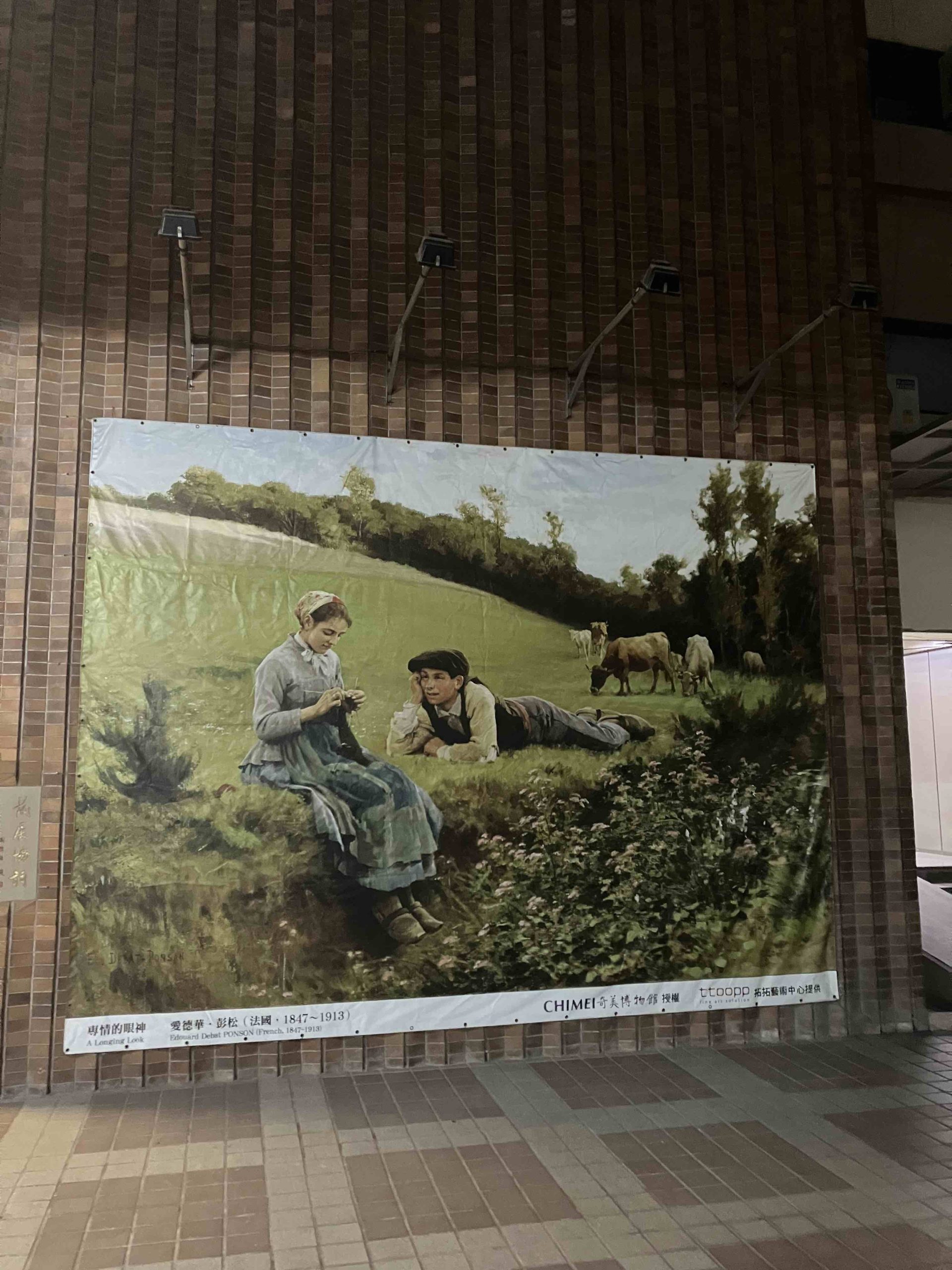
Anyway, it‘s mostly not an apartment building. It’s what you might call mixed-use, with the mix heavily tilted toward the commercial side. I think the company that runs the second-floor hotel just wanted to try its hand at apartments, so they bought a couple on the floor just below their fourteenth-floor office, papered the walls, put in some Ikea furniture and new appliances and put an ad on Taiwan‘s main apartment-hunting app, www.591.com.tw.

The wallpaper, which has a print meant to make the walls look like they’re covered in rough-hewn wooden boards, can’t cover up the fact that this is an aging, poorly maintained building. One of the main signs of that is the thin, loose windows. When we first looked at the apartment, the windows were cracked open, and perhaps that‘s why it didn’t occur to me that traffic noise would be a problem. Of course the apartment is noisy: the windows are open. I didn’t know then that when the windows are closed the noise level would be pretty much the same. We hear the buses, cars and mopeds zooming around in the street below, the honking of horns, people talking loudly to one another (including, occasionally, at 4 am–it seems there’s a karaoke place or something that closes around that time). You might think, thirteen floors up, that things would be quieter, but it doesn’t actually seem to be the case. We hear, several times a day, the distinctive Für Elise melody that the garbage trucks play to let folks know they’re coming. We even hear the “ding-dong” sound that Taipei’s rental bikes make when you check them out or turn them back in. When it’s windy, the wind whistles loudly through the spaces in the windows.
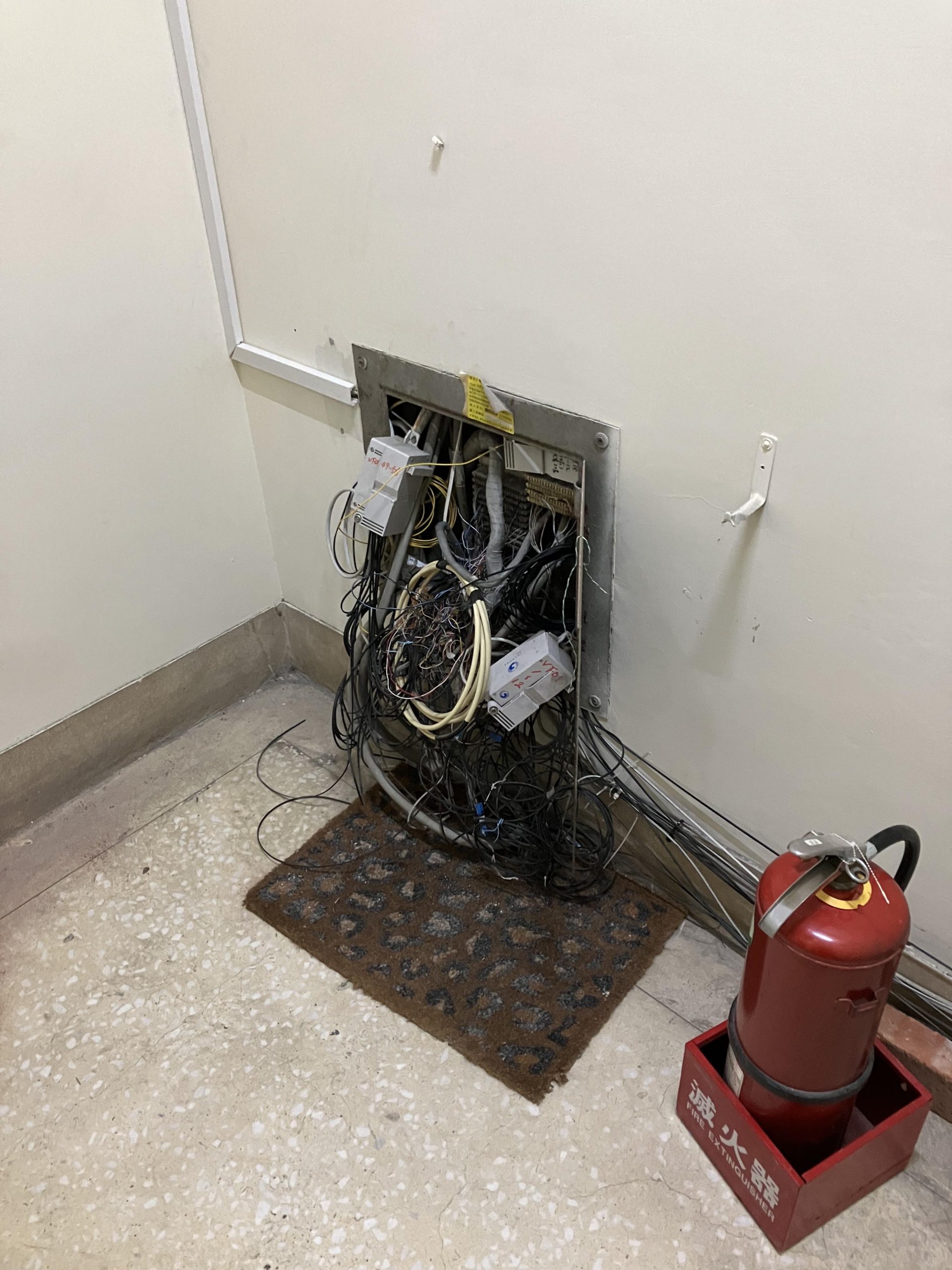
The building also has a serious mosquito infestation. One of our most useful purchases so far has been a fly swatter. Morning and evening we go around and kill mosquitoes resting on the walls and windows. And still they come. Lawrence has been thoroughly bitten up; one morning when I went in to wake him for school, I found him with his whole head swaddled in his jacket to keep the mosquitoes from getting to his face. Finally, the kitchen sink has no hot water. The bathroom does, fortunately, but not the kitchen. Oh, and when I took the stairs one day instead of the elevator, I discovered that each level of the stairwell has a gnarly bundle of wires spilling out of the wall that surely can’t be up to code:
In sum, this fancy-looking apartment is not all it seems. But its peculiarities are bearable. If it weren’t for its one main shortcoming I’d simply have put up with them and shaken my head in disgust at what a sucker I’d been to pay so much for it. I would never have contemplated breaking the contract and moving to a new place if it weren’t for this apartment’s fatal flaw. I’ll tell you about that in the next post.