
Presentation given at Christ Church United Methodist, Denver, CO, 27 September 2026.
The last time I spoke at this seminar I talked about the early medieval philosopher Boethius and his most famous work The Consolation of Philosophy, which was written in AD 523. It is a rumination on the vicissitudes of fate and how faith in an ultimate good and order can be maintained even while you are continually carried up and down by the Wheel of Fortune, which awards and takes away worldly wealth and power seemingly capriciously.
I suggested in that presentation that Boethius was alive at a time when the old order of the Roman Empire was being swept away by something new, and that his reaction to some of the events of his time, like a crowd of barbarians taking over the government and running its form now for their own benefit, might have some lessons for us today.
C. S. Lewis, as a scholar of medieval literature and languages—and in his better-known role as Christian apologist—appeared a few times in that talk. Lewis was a big fan of Boethius and thought The Consolation one of the most important works for understanding Medieval learned culture. I wanted to make the point that, if we feel today that the world is facing an important crisis, it would not be the first time even in living memory that people felt that way. Lewis himself fought in the trenches in France in World War I, lived through the Great Depression and World War II, and died in the midst of the Cold War.
I ended that last presentation with Lewis’s advice to those worried about nuclear war, to not let the fear of it dominate their lives and to “let that bomb when it comes find us doing sensible and human things: praying, working, teaching, reading, listening to music, bathing the children, playing tennis, chatting to our friends over a pint and a game of darts—not huddled together like frightened sheep and thinking about bombs.”[1]
I did not want to suggest that we can simply ignore the perils of our current moment and go on about our lives as if everything were normal. But rather that our everyday lives—the small, common good that we do ourselves and those around us every day—was as important to the meaning of our lives as the fight against the many powerful evils the wheel of fortune has currently raised up. Indeed, the two things might be the same thing.
In this talk I return to C. S. Lewis and what I think are some of his lesser-known works: The science fiction trilogy he published between 1938 and 1945—in particular the first book, Out of the Silent Planet, as that one most involves space travel and is where the structure of the cosmos of the books is most fully explained to the protagonist. I want to look at why Lewis wrote the books, why he chose science fiction—or “scientifiction” as he often termed it—as the genre, and, especially, at the Medieval world view that informed them.
C. S. Lewis
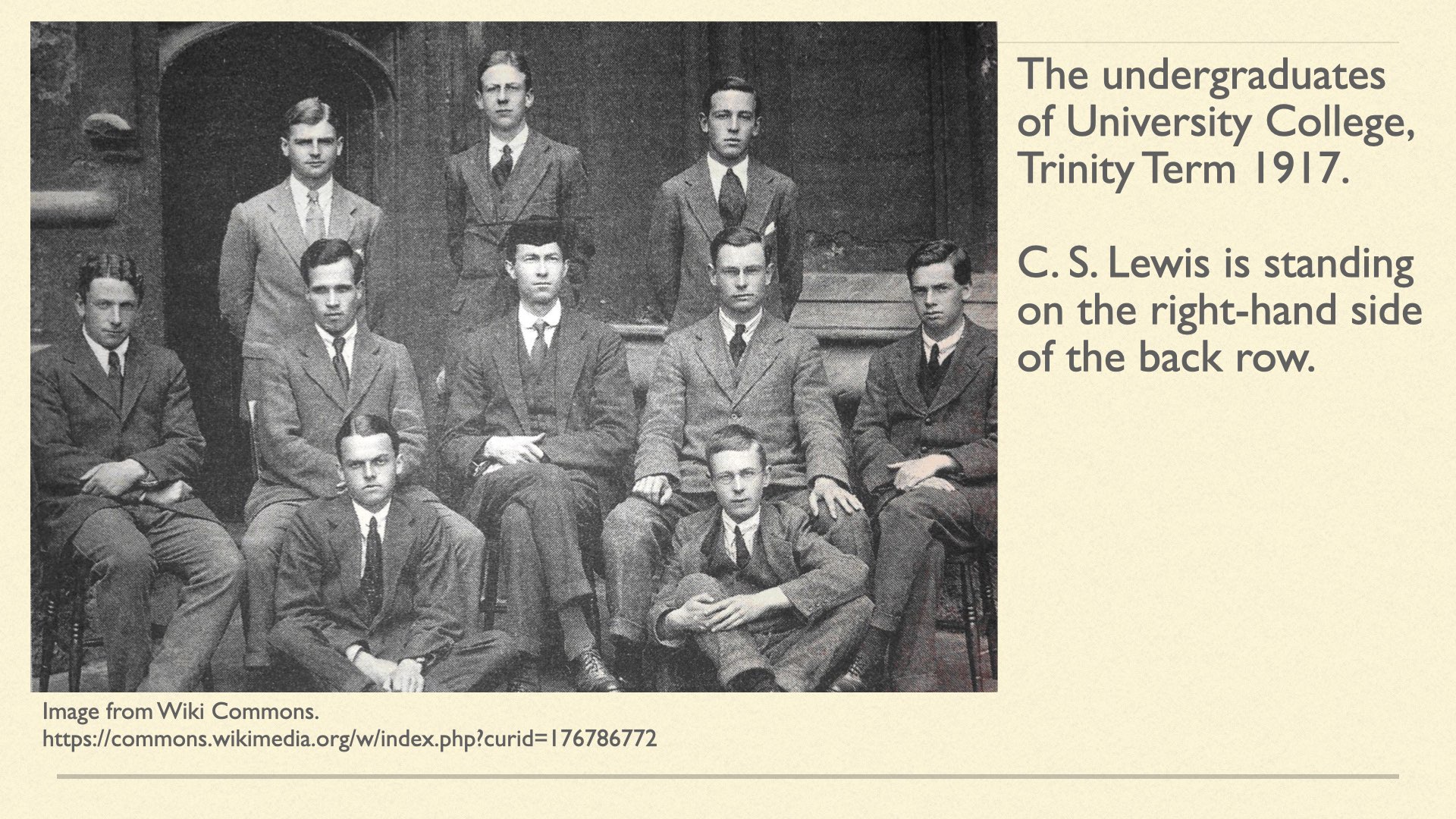
So first, who was this C. S. Lewis guy? In the image above he is a young man, an undergraduate at Oxford in 1917.
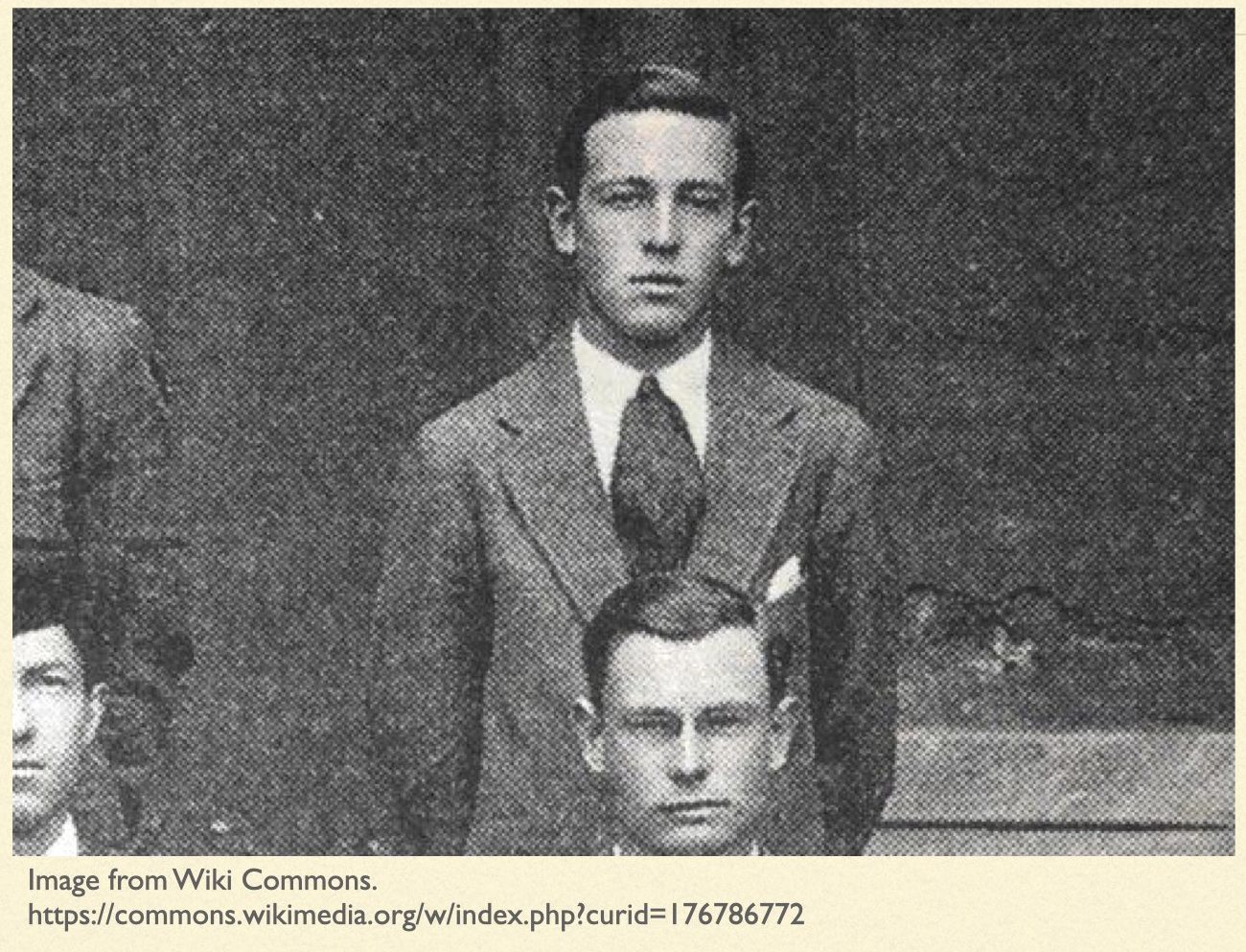
This is just a crop of the previous image so you can see him better.

And here he is in about 1956 or 57.
He is best known today, I think, for being a popularizer (a popular popularizer) of Christian ideas though his essays and fiction, especially the Chronicles of Narnia, which were published in the 1950s. But he was also, maybe primarily, a scholar. He spent most of his adult life, from 1925 to 1954, teaching medieval literature at Oxford, where his lectures attracted standing-room-only crowds.
One of his colleagues remembered him as someone who appeared “to have read everything and remembered everything he read.” A student of Lewis’s in the 1950s remembered a game he and Lewis would play where the student would choose a book at random from Lewis’s shelves, then read a line from a randomly chosen page. Lewis, said the former student, would always be able to name the book and usually “quote the rest of the page.”
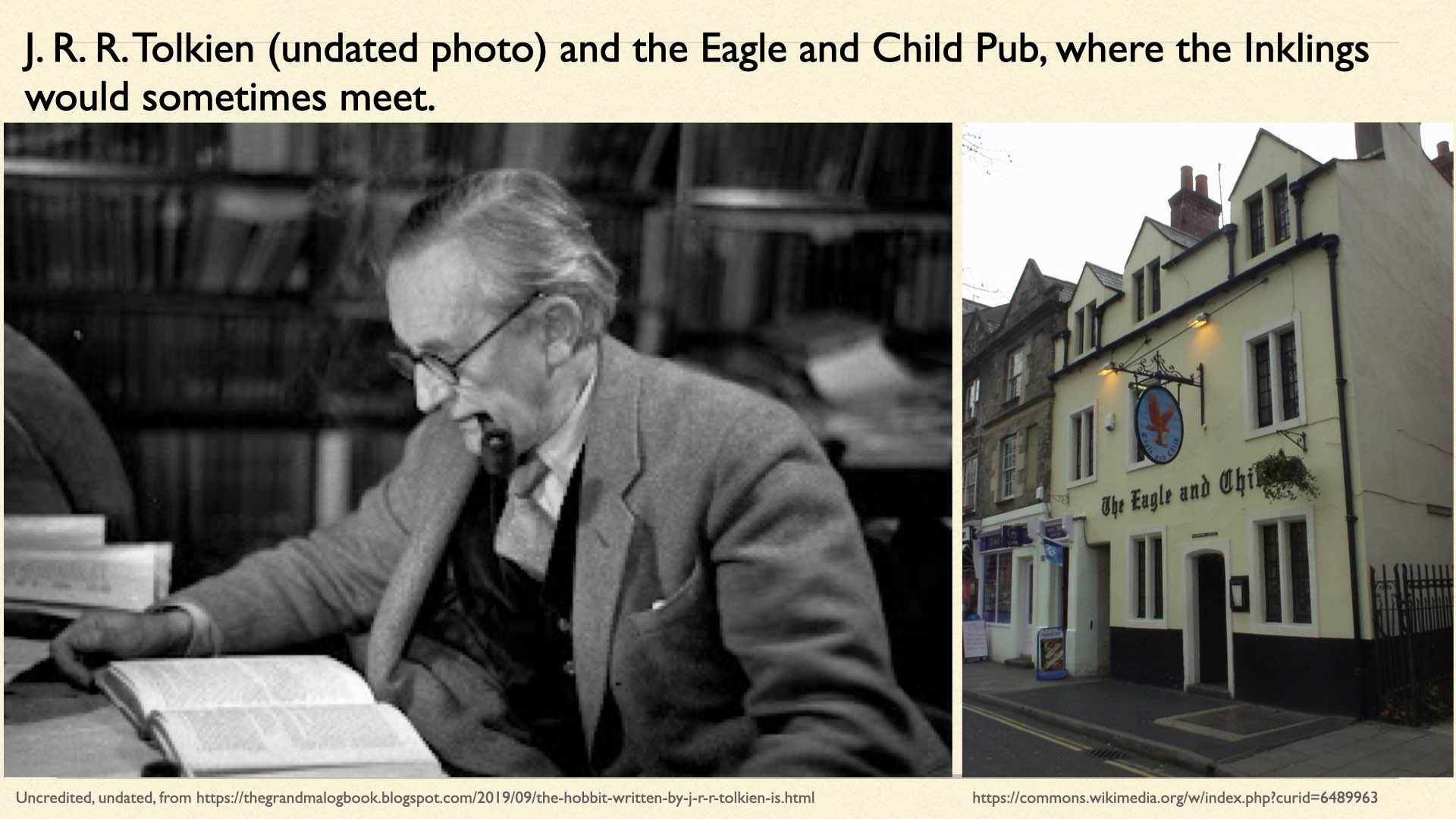
It was at Oxford that Lewis met philologist J. R. R. Tolkien and become involved in an informal group called “The Inklings,” which met to read and discuss fiction and fantasy, often drafts of stories written by members of the Inklings. It is from his association with Tolkien that Out of the Silent Planet originated. Sometime in 1937 Lewis suggested that since the kinds of “excursionary thriller” stories they liked weren’t being written much anymore, they should each write one of their own. Lewis chose to write a space story and produced Out of the Silent Planet. Supposedly he produced the entire draft longhand and made no revisions—he never learned to use a typewriter (and never learned to drive, either). Tolkien’s effort, “The Lost Road,” was never finished but it involved the same fictional world featured in The Hobbit, which was published that same year.
It was also during his time at Oxford, encouraged by Tolkien and others, that Lewis became a Christian. He had been raised in Ireland in a conventionally though not passionately religious family. His mother died of cancer when he was only nine and his father seems to have been somewhat distant. By his mid-teens (1913 or so) he was an outspoken atheist and his experiences in World War I deepened his skepticism. Conversion to Christianity was something of an emotional and intellectual struggle for Lewis, and some of this experience would later be described in parable form in parts of the science fiction trilogy. But he described the final moment like this:
That which I greatly feared had at last come upon me. In the Trinity Term of 1929. I gave in, and admitted that God was God, and knelt and prayed: perhaps, that night, the most dejected and reluctant convert in all England.
During World War II, Lewis volunteered for the armed forces, but served only in the local home guard. He also made a series of appearances on BBC radio, speaking about religious topics. Those talks were also published during the war and later became the basis for the book Mere Christianity, published in 1952.
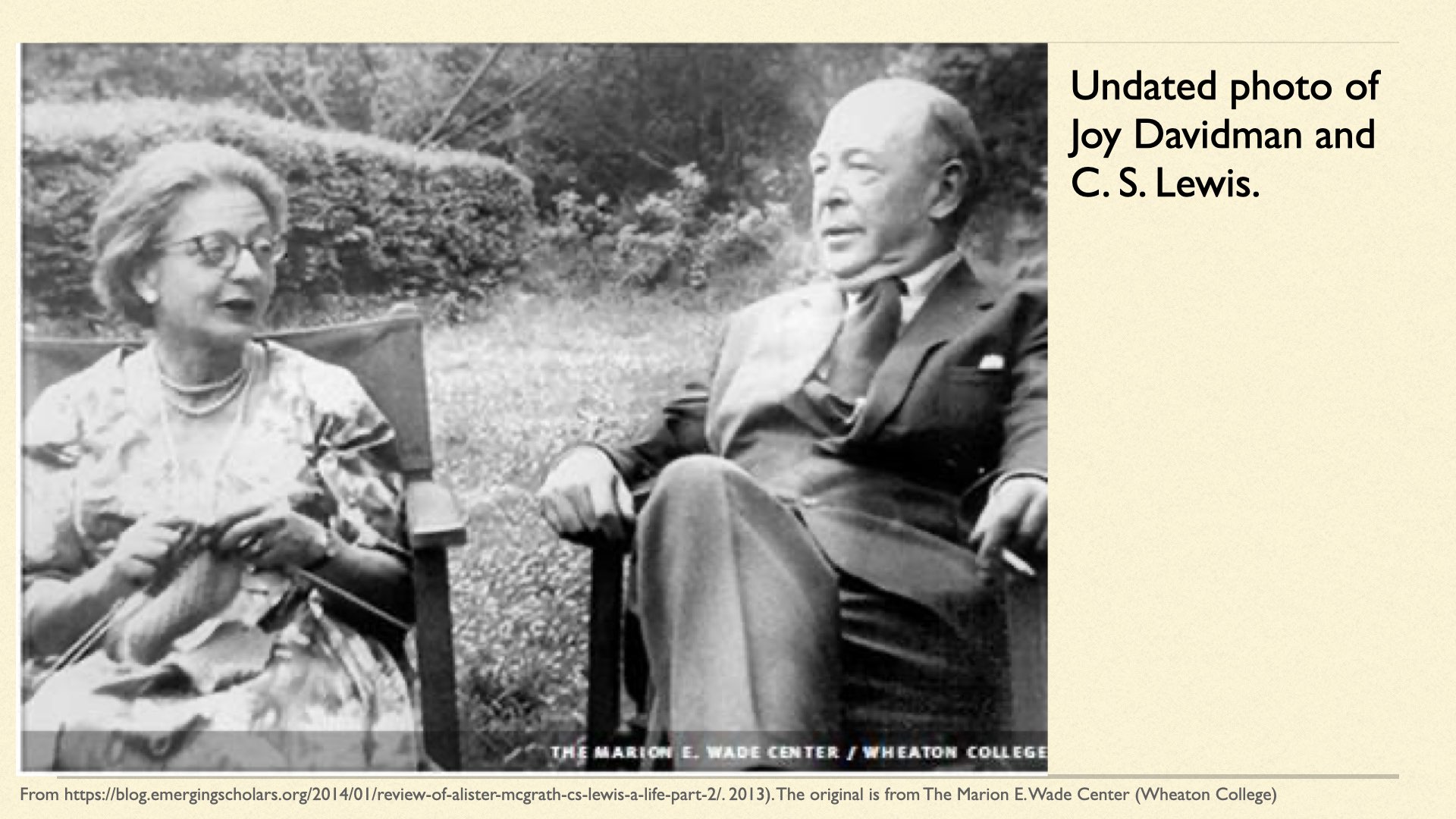
Lewis married Joy Davidman, an American poet and writer, in 1956, when he was nearly 60. They married first in a civil ceremony only to help Davidman remain in the UK. The next year Davidman was diagnosed with terminal bone cancer and the couple—now actually a couple—decided on a proper Christian marriage, which was performed at Joy’s hospital bedside in 1957. After a remission of several years, Joy’s cancer returned and she died in 1960. Lewis himself died of kidney failure in 1963.
The Medieval Cosmos

From the life and background of Mr. Lewis, let’s turn now to the Medieval cosmos. Our primary guide will be… C. S. Lewis. One of the last things he worked on before he died was the book The Discarded Image, which was published posthumously in 1964. Its subtitle says it is “An Introduction to Medieval and Renaissance Literature” but it is more a description of what Lewis thought might have been the greatest work of the Middle Ages—their synthesis of “theology, science, and history into a single, complex, harmonious mental Model of the Universe.” This, he says, formed the “backcloth” of much Medieval literature and familiarity with it helps unlock the meaning of many medieval works.
This synthesis does not have a birthdate but Lewis says the most important years of its development were roughly 200 AD to the mid-500s AD. As the sharp-eyed will notice this begins before the date usually given for the fall of the Roman Empire, 476, and before Christianity become the official state religion of Rome in 380. Much of the material of the synthesis is not Christian, then, but classical, drawing from Plato, Aristotle, and others. It held sway until the 1600s, so it was the “backcloth” of much of European thought for about 1,000 years.
One of the sources of the synthesis is the authority Medieval thinkers gave to books, especially old books. Lewis says that besides their love of system and organization:
They are bookish. They are indeed very credulous of books. They find it hard to believe that anything an old auctour has said is simply untrue. And they inherit a very heterogeneous collection of books; Judaic, Pagan, Platonic, Aristotelian, Stoical, Primitive Christian, Patristic.
The older a text was thought to be, the better its authority. It was a fragment of some antediluvian unity of knowledge that had been lost. Their own age—the Earth itself, really—was not the exalted product of some ages-old process of development but rather the degraded remnants of a previous glory. Or, as Lewis puts it: “In modern, that is, in evolutionary, thought Man stands at the top of a stair whose foot is lost in obscurity; in this [the Medieval model], he stands at the bottom of a stair whose top is invisible with light.”
The model is very hierarchical, but there is no striving of the lower against the higher or vice-versa. It is harmonious. Everything found its place by means not of laws or forces but from “sympathies, antipathies, and strivings inherent in matter itself. Everything has its right place, its home, the region that suits it, and, if not forcibly restrained, moves thither by a sort of homing instinct.” Purer, lighter things move higher and go faster. Less pure things sink lower and move slower.
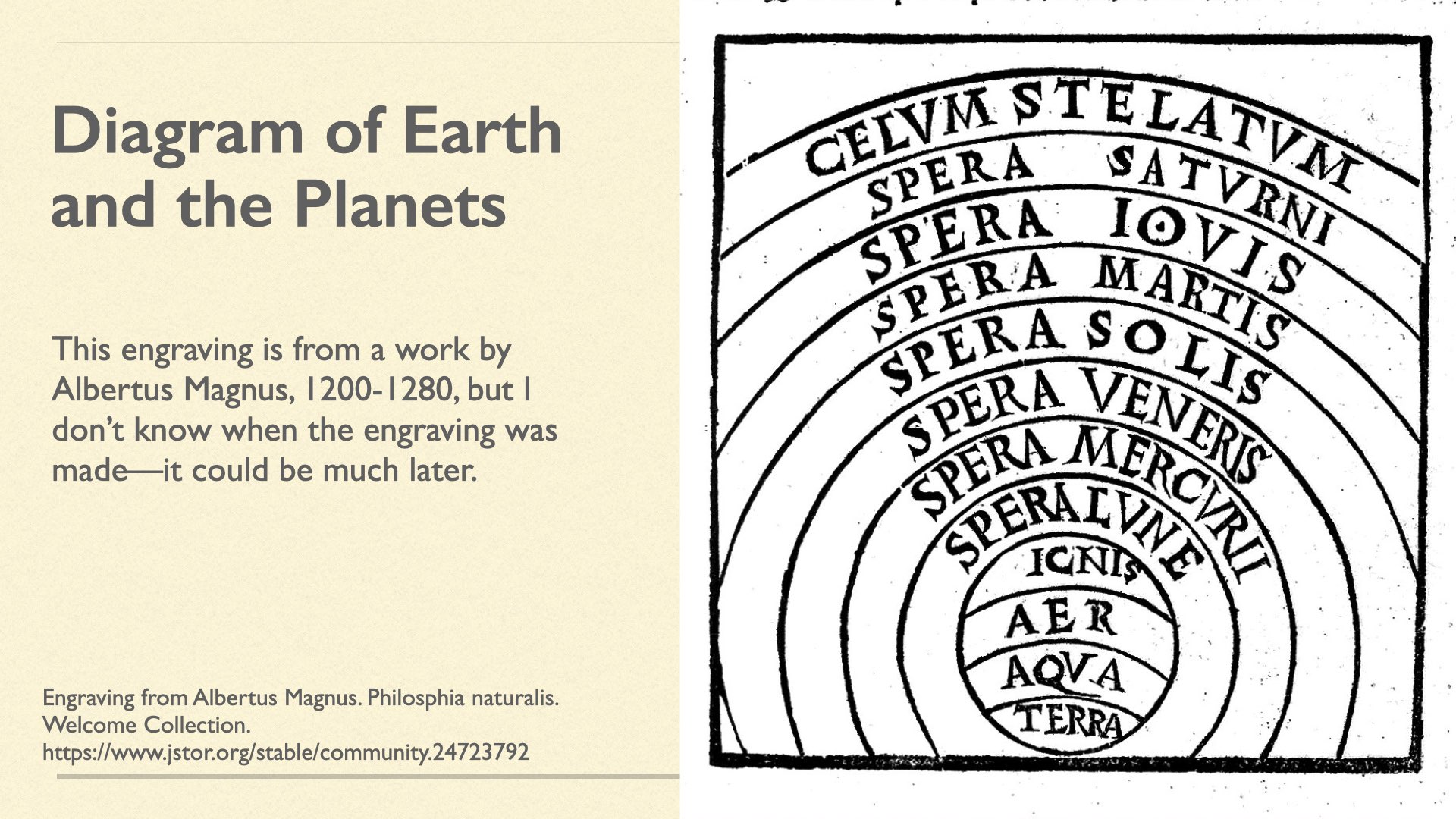
The universe consisted of a series of nested spheres, each with its own intelligence (though not an embodied being) that guided it in its movements. Below the orbit of the moon are the four elements: earth, water, air, and fire. Each element finds its proper place: earth, being the heaviest, moves toward the bottom, or center. Water is on top of the earth, the air above, and then fire. The fire we see on earth is impure, and so is visible to us. But pure fire, which rises above air and forms a sphere around the Earth just below the Moon, is invisible to our eyes, so we can see through it to the Moon, planets and stars.
The sphere of the Earth is stationary and each sphere above it moved with increasing speed, transmitting some of its motion to the sphere below it. Beyond the orbit of the moon was the fifth element—the quintessence or aether. The orbit of the Moon marked the boundary between the common, changeable elements, and the more-perfect, unchanging heavens.
Above the Earth came the seven planets: the Moon, then Mercury, Venus, the Sun, Mars, Jupiter, and Saturn. (Yes: the Moon and the Sun counted as planets.) Each of these had its associated influences and characteristics which could affect life on earth. Beyond the sphere of Saturn was the Stellatum, which carried the fixed stars. Beyond that was the First Movable, or Primum Mobile. This sphere carried nothing visible from Earth but its existence was inferred because of the movements of the other spheres. Think of it perhaps as the Dark Matter of the Medieval universe.
Beyond the First Movable is, for Aristotle, “neither place nor void nor time.” In Christian terms, of course, this becomes heaven itself—“pure light, intellectual light, full of love.”
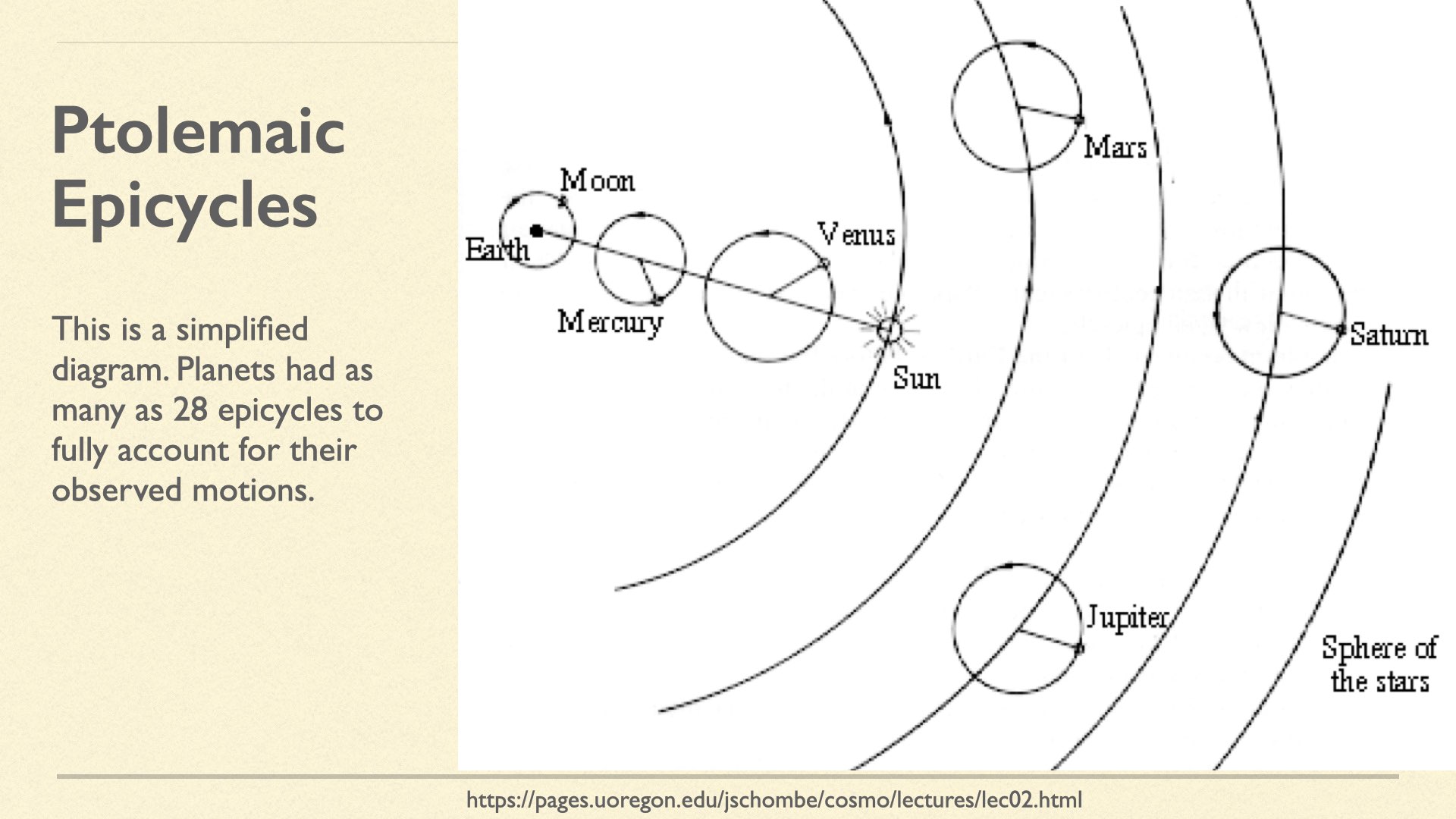
Probably many of you are familiar enough with the Ptolemaic model of the solar system that you are wondering where in this model are the epicycles, equants, and deferents and the like, which were used to make the predicted positions of the planets match observed positions. Lewis dismisses this curtly by saying “They contribute less to the emotional effect (which is my chief concern) and can hardly be made intelligible without diagrams.” But earlier he admits that “On the highest level, [of astronomical research], then, the model was recognized as provisional.” He quotes Aquinas:
‘In astronomy’, says Aquinas, ‘an account is given of eccentrics and epicycles on the ground that if their assumption is made … the sensible appearances as regards celestial motions can be saved. But this is not a strict proof … since for all we know they could also be saved by some different assumption.’
So in this way the mathematics necessary to make the model work for astronomers was a problem for astronomers but less so for the philosophers and poets who also referred to the model. The mathematical models did not have to be “fullest reality,” they were an abstraction or parable to better describe observed planetary movements, not necessarily how the real system worked.
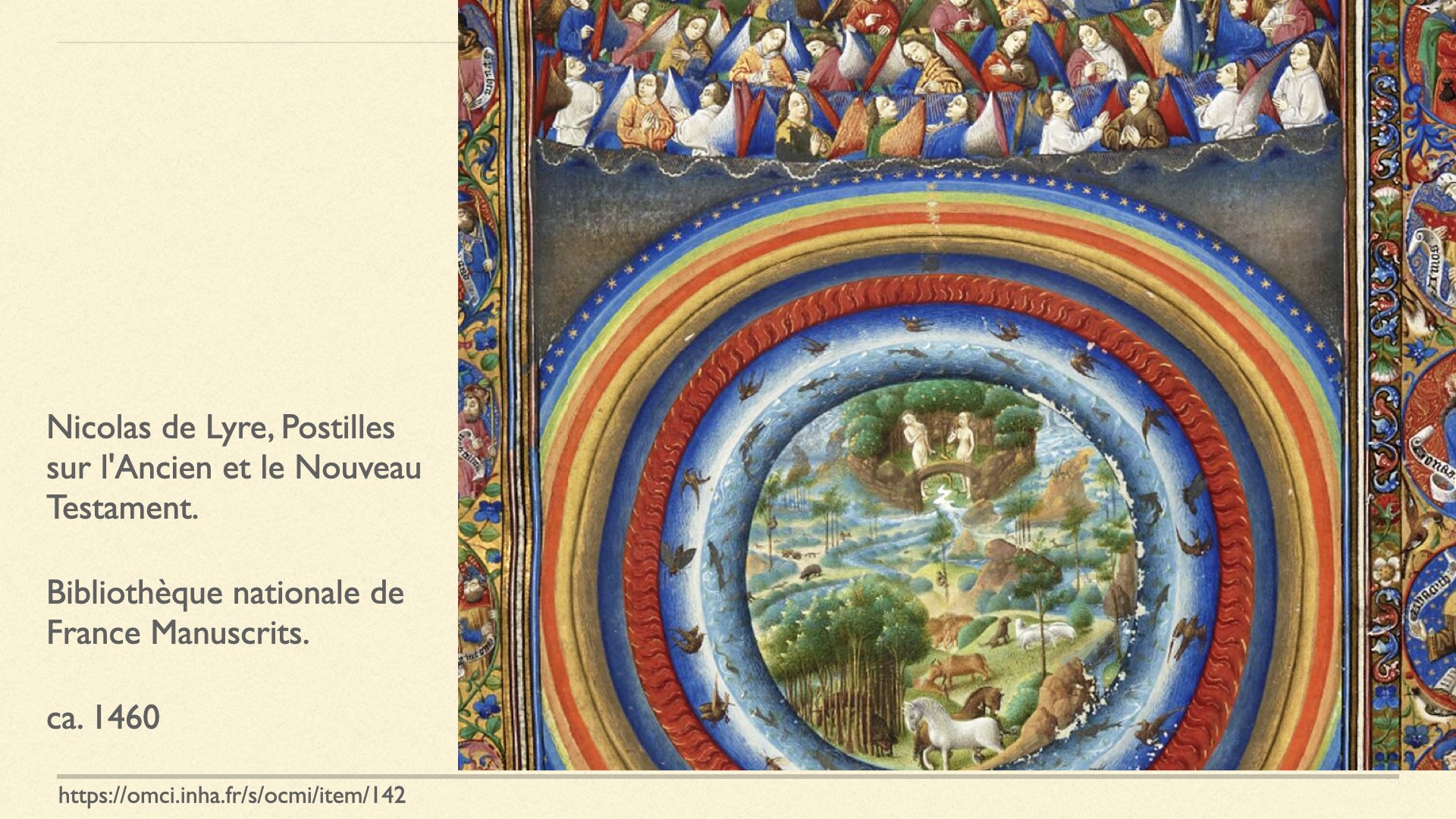
Lewis also makes the point that, though the Sun is ranked among the planets and occupies the fourth sphere from the Earth, in some ways the model was more heliocentric than our current model. In the Medieval model all the light in the universe came from the sun. Even the distant stars—so far away and much larger than the Earth—did not make their own light but merely reflected the light of the sun.
Nowhere, then, is the modern concept of space as a cold, dark, lonely void. It was not space but “the heavens,” suffused with light and moved by the love of God. It was not even silent. Each planet in its sphere made harmonious music as it orbited in its sphere. The night sky looked black only because you were looking through the narrow cone of Earth’s own shadow. In reality you were “looking up at a world lighted, warmed, and resonant with music.”

In only one respect, perhaps, might the model encourage melancholy. For though the Earth was at the center of the model, the center was also the bottom—the lowest place. At times Medieval writers seemed to turn the model inside out, because, according to Dante, “the spatial order is the opposite of the spiritual, and the material cosmos mirrors, hence reverses, the reality.” Earth is, in Lewis’s metaphor, in the suburbs, far outside the city wall. At night, when we look at the stars, we’re looking up but also in toward the eternal city and the central castle of God.
The Trilogy

With some understanding, then, of the Medieval cosmos, let’s look briefly at the books themselves. I’m going to talk mostly about the first one, Out of the Silent Planet, published in 1938. The trilogy gets progressively weirder in books two and three, for one thing, branching off into genres that are more clearly fantasy and horror. Plus, this first book is more concerned about the Medieval cosmic model than the other two.
In Out of the Silent Planet a philologist named Ransom (based on Tolkien, supposedly) is abducted by a physicist named Weston and his greedy associate Devine. They take Ransom to another planet—Ransom is not sure at first what planet it is but eventually we discover that it’s Mars. Devine is purely interested in collecting gold from Mars, but Weston has grander plans for colonizing the planet to help ensure the continuation of the human race. They have brought Ransom to Mars as a human sacrifice, because they think one of the people of Mars—the Sorns or Seroni—want to experiment on him.
Shortly after arriving on Mars, Ransom escapes from Weston and Devine and through his journeys encounters various intelligent creatures on Mars: the otter-like Hrossa, who live near lakes and are skilled at hunting, agriculture, and poetry; the scientist-like Seroni, who live in the mountains; and the craftsmen Pfifltriggi, who live in the forested lowlands. Because Ransom is a philologist he’s able to learn the language fairly handily and he learns about the history of the planet and the solar system. He discovers that the planet is ruled by a benevolent spirit called an Oyarsa and their angel-like servants the Eldil. Mars itself is known to them as Malacandra and the Earth as Thulcandra, or the silent planet.
Each world has its own Oyarsa who serve a higher power, known as Maleldill. But the Oyarsa of Thulcandra rebelled against Maleldill. He became “bent” and fought against Maleldill and the other Oyéresu. Eventually he was imprisoned on the Earth and the reach of his powers limited to the orbit of the moon. One of the costs of this struggle, though, was the loss of much of the Malacandran atmosphere. Malacandra is a dying planet, and its residents know it. It is cold and the fossils of many extinct species of plants and animals occupy now uninhabited zones of the planet. But Maleldil and the Oyarsa have done what they can and carved out valleys where the atmosphere is thicker and the warmth and water nearer the interior of the planet can nourish life on the surface.
At the climax of the novel Weston and Devine have been captured and brought to the Oyarsa, where Ransom has already arrived. The physicist tries to talk with the Oyarsa but, as he does not know Old Solar very well, his attempts to intimidate what he thinks are primitive beings with the awesome power of man and his technology do not come off at all. He gives up and asks Ransom to translate what he thinks is a stirring speech justifying the conquest of Mars by humans so that man, in whatever form future evolution and eugenics might render him, might go on to still other worlds and other star systems and so live forever:
‘It is in her right,’ said Weston, ‘the right, or, if you will, the might of Life herself, that I am prepared without flinching to plant the flag of man on the soil of Malacandra: to march on, step by step, superseding, where necessary, the lower forms of life that we find, claiming planet after planet, system after system, til our posterity—whatever strange form and yet unguessed mentality they have assumed—dwell in the universe wherever the universe is habitable.’
‘He says,’ translated Ransom, ‘that .. it would not be a bent action—or else, he says, it would be a possible action—for him to kill you all and bring us [humans] here. He says he would feel no pity. He is saying again that perhaps they would be able to keep moving from one world to another and wherever they came they would kill everyone…’
The Oyarsa doesn’t think it’s right that Weston and Devine be killed, since they are not inhabitants of his own world. Instead he decides to send them back to Earth. Ransom is given the option to stay behind or return with them and he chooses to return, though the chances of their survival are slim.
They do get back to Earth, after a perilous voyage. But after they crash land, Weston and Devine quickly disappear, leaving the exhausted Ransom alone in the spaceship. Ransom crawls out, recognizes where he is—England, luckily—and immediately goes to the nearest pub for a pint.
In the last chapter Lewis lets himself into the story and writes in the first person, explaining how he came to know Ransom and relate the tale of his travels, and why they decided that writing a book of fiction might be more effective for their purposes than trying to convince people that the events related actually occurred.
More briefly, here is what happens in the other two books, in case you’re curious.
The second book, Perelandra, takes place on Venus, or Perelandra in Old Solar. Ransom is sent there by the Oyarsa of Mars to help stop a plot by The Bent One. Venus—younger than either Mars or Earth—is a watery, Eden-like world inhabited by just two people—the Green Lady and The King. Weston re-appears, having been possessed by servants of The Bent One to tempt the Green Lady into disobeying Maleldil. Ransom attempts to prevent that and eventually they begin a to-the-death struggle that Ransom ultimately wins. Then he gets to meet the King and witness his and the Green Lady’s assumption of power on Perelandra—a vision of paradise not lost.

The book covers shown here are not the originals, by the way, just ones I most amusing ones I found in an Internet search.
The third book—That Hideous Strength—takes place on Earth and is a weird mix of Arthurian legend and satire of academic institutions. The main protagonists are a newly-married academic couple, Mark and Jane, who have moved to a new town for Mark’s new job. He becomes involved with researchers at the National Institute of Co-ordinated Experiments, or NICE. NICE is supposedly dedicated to scientific research but in reality it is being used by The Bent One. They are trying to discover the resting place of Merlin the Magician and have employed Mark to get to Jane, who has dreams that foretell the future. Mark’s voyage into the governing hierarchies of NICE is based on Dante’s description of hell and, though he recovers his good moral sense in time to save himself, he gets to meet the head of NICE, who turns out to be an actual disembodied head kept alive by the powers of The Bent One. Eventually Merlin, with the help of Ransom and the Oyéresu, destroys NICE and its evil denizens all die various gruesome deaths.
Medieval Elements
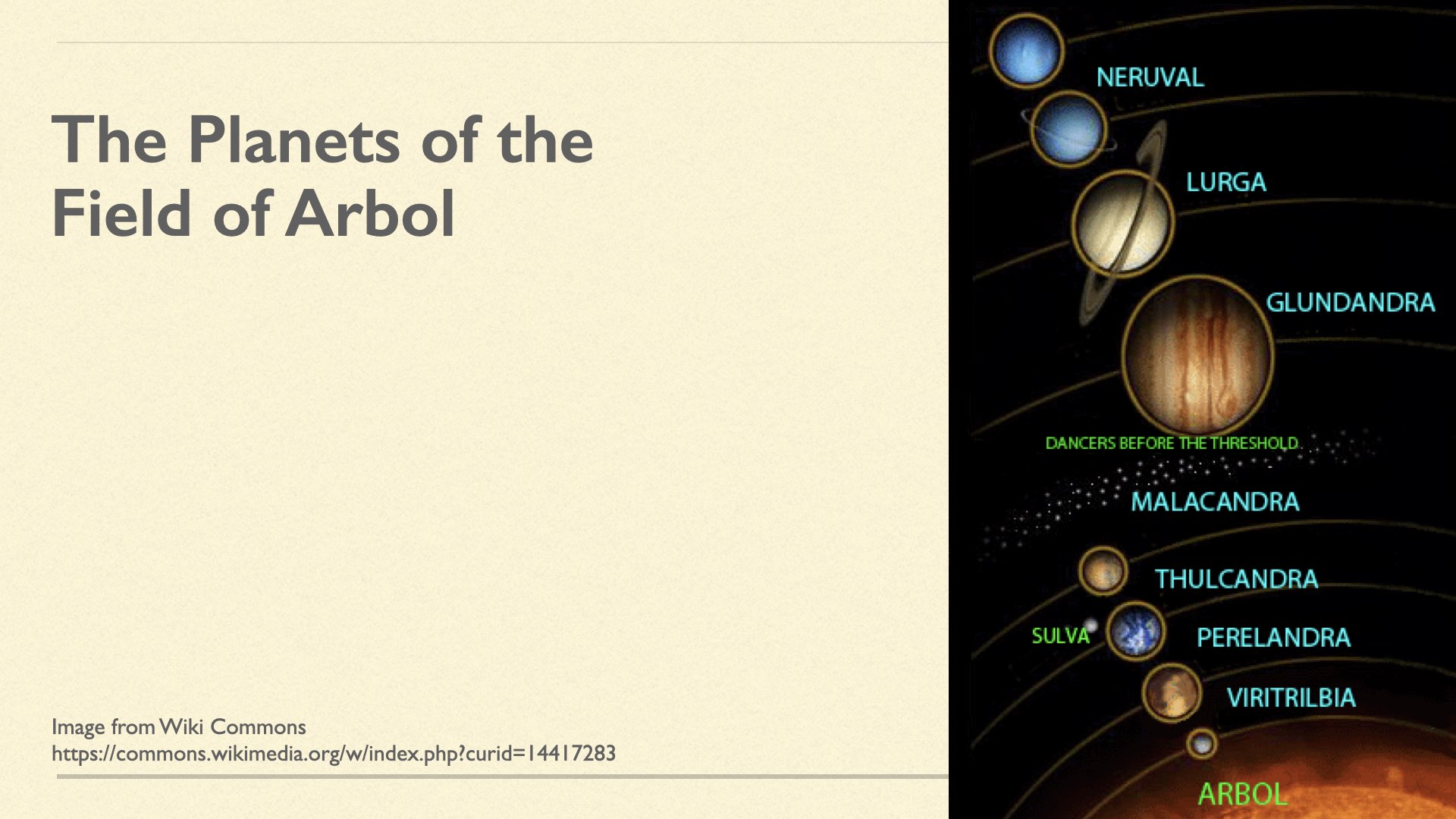
So that’s a synopsis of the trilogy, and here on this slide is a diagram of the Solar System in the trilogy. As you can see it’s not exactly the Medieval model. The Sun is at the center, for one, and there are planets beyond Saturn. This diagram makes it appear as if there are circular orbits, but that’s not the case. The shape of the orbits is never mentioned in the books but I assume they are eccentric, as we would think today to be correct.
But if there are no crystalline spheres, there is a spirit—an Oyarsa—for each planet that guides it along according to the will of Maleldil, or God, or the Unmoved Mover. The Oyéresu are helped in their endeavors by the eldil, which are not very visible to humans but can travel to other planets save one: The Earth.
The Earth is the Silent Planet because of its bent Oyarsa, who has disrupted the natural harmony of the planet by tempting men to believe that each of them could be their own little Oyarsa and disobey the wishes of Maleldil. Everything beneath the orbit of the moon—the sublunary realm of the Medieval model—is within the reach of the Bent One and is thus corrupted, impure, and filled with strife. On Malacandra, on the other hand, they have a harmonious society with each species in its proper zone and doing the things proper to it.
And there is the heavens, not space. In the spaceship traveling to Mars, once beyond the Moon, Ransom at first he finds the extremely bright and pale light of the sun painful, and he must wear dark glasses to protect his eyes. But soon he realizes that exposure to it seems to suffuse him with feelings of health and well-being and he seeks it out:
He had read of ‘Space’: at the back of his thinking for years has lurked the dismal fancy of the black, cold vacuity, the utter deadness, which was supposed to separate the worlds. He had not known how much it affected him till now—now that the very name ‘Space’ seemed a blasphemous libel for the empyrean ocean of radiance in which they swam. He could not call it ‘dead’; he felt life pouring into him from it every moment.
Why Science Fiction?
What were Lewis’s motives for writing the trilogy and why did he choose science fiction as the genre? In the first place because he liked science fiction. In 1955 he gave a talk about science fiction in Cambridge, classifying it into several sub-genres. In that talk he says “I had read fantastic fiction of all sorts ever since I could read, including, of course, the particular kind which Wells practised in his Time Machine, First Men in the Moon and others.” In the roughly 5,000-word talk (about the size of this presentation) Lewis comments on no less than 60 specific authors and works. Out of the Silent Planet itself is clearly based on the H. G. Wells story, The First Men In the Moon, published in 1901, a debt which Lewis acknowledges in the book’s epigraph.
Lewis wasn’t anti-science or anti-science fiction. His target instead was a type of “evolutionism” or “scientism” that he found prevalent in much science fiction—and in other parts of modern culture as well. It portrayed humanity as relentlessly pushed forward by scientific or technological progress in a way completely untethered to moral concerns. In Perelandra, Ransom fumes at the motives of Weston:
He was a man obsessed with the idea which is at this moment in obscure works of ‘scientifiction,’ in little Interplanetary Societies and Rocketry Clubs, and between the covers of monstrous magazines… ready, if ever the power is put into its hands, to open a new chapter of misery for the universe. It is the idea that humanity, having now sufficiently corrupted the planet where it arose, must at all costs contrive to seed itself over a large area … The destruction or enslavement of other species in the universe, if such there are, is to these minds a welcome corollary.
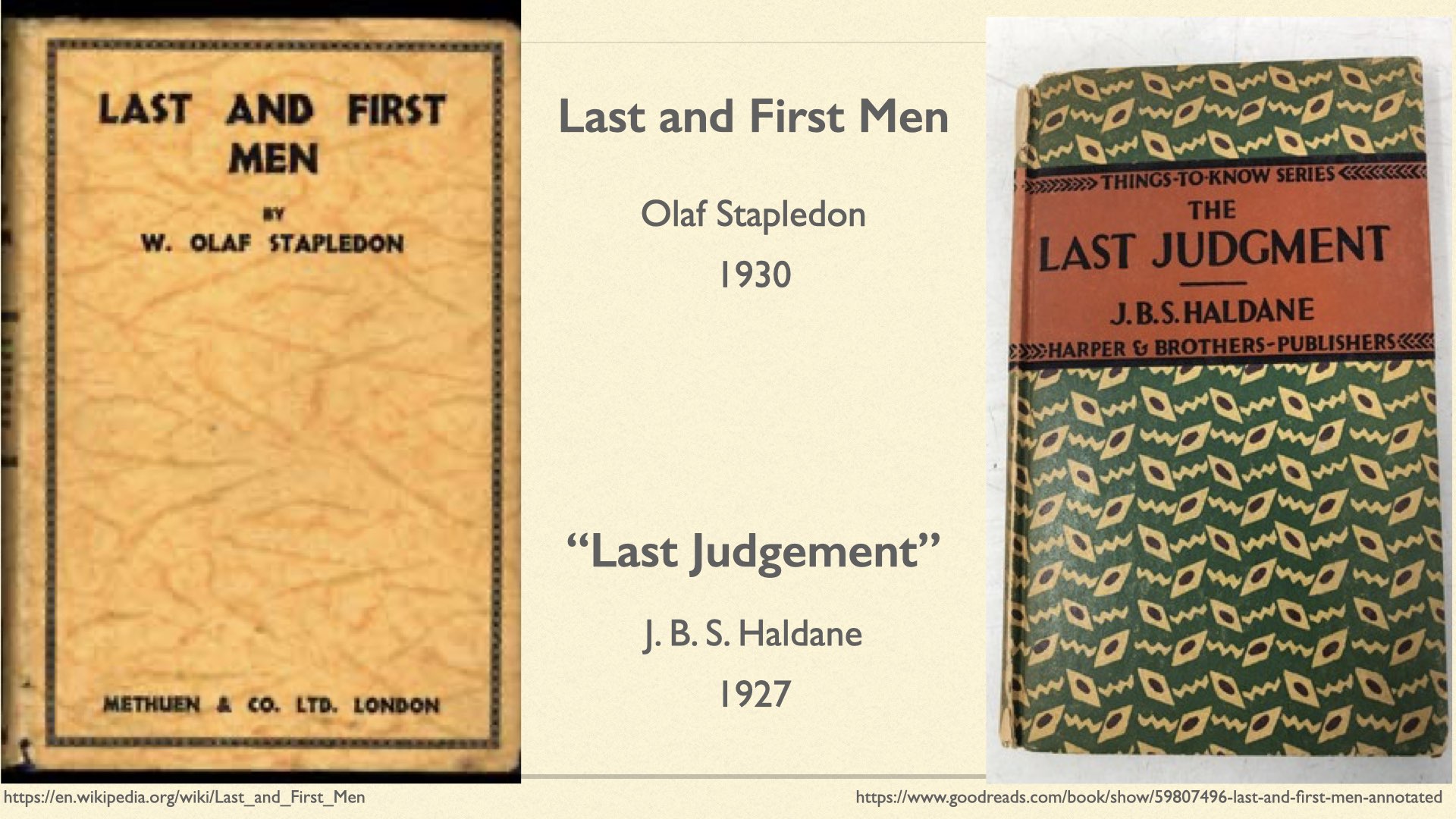
This was an idea especially associated for Lewis with authors like Olaf Stapledon, an English philosopher who also wrote works of speculative fiction such as Last and First Men, published in 1930, and the eminent biologist J. B. S. Haldane, whose essay “The Last Judgement,” published in 1927, envisioned future civilizations of men shaped by deliberate genetic engineering and eugenics. It was the idea that the presumed telos of man’s civilization was just to go on and on, exterminating whatever and whomever stood in the way. In a letter to his later biographer Lewis explained that he viewed “the whole inter-planetary idea as a mythology and simply wished to conquer for my own (Christian) point of view what has hitherto been used by the opposite side.”
In Out of the Silent Planet, Ransom explains to Lewis (the character in the book) one of the reasons for rendering the tale of his voyage to Mars as fiction rather than as non-fiction was to reach a wider public and that a few among the public would see through the fiction to the facts beneath. “‘Anyway,’ he [Ransom] continued, ‘what we need for the moment is not so much a body of belief as a body of people familiarized with certain ideas. If we could even effect in one percent of our readers a change-over from the corruption of Space to the conception of Heaven, we should have made a beginning.”
And that is also why I think this book and the Medieval model is still worth talking about today. Not because I want to spread Christianity but because I think, as Pastor Emily said in her talk last week, that people are looking for a better sense of connection to each other and to the world. And I think the world needs that, too.
Seeing the Heavens

So how might we do that? Well, each of us will have our own way. But we might take a cue from C. S. Lewis and try to spend more time outdoors, with actual people, experiencing the world as much as possible as someone in Medieval Europe might have.
In The Discarded Image Lewis at several points has difficulty explaining some concepts as they were understood by people in the Medieval age. For instance, trying to describe the character influences of Mercury, he quotes a variety of Medieval authors who give an array of disparate attributes, then admits “It is difficult to see the unity in all these characteristics. … But it is better just to take some real mercury in a saucer and play with it for a few minutes. That is what ‘Mercurial’ means.”
And a bit later: “..the planetary characters need to be seized by an intuition rather than built up out of concepts; we need to know them, not to know about them, connaître not savoir.”
Similarly, in discussing the Medieval concepts of the scale of the universe—a vast but finite space (like a giant cathedral), the music of the spheres, and the feeling of looking in toward the center of the universe while you are looking out at the night sky, Lewis urges the reader to go out on a dark night and look up. It is simply something that must be experienced first hand to be known.
Unfortunately, the modern world makes this more difficult than ever. We are more and more isolated, sequestered in our silent planet. Two decades ago, in graduate school, I was the teaching assistant many times for a history of science fiction class. This was what first prompted me to read Out of the Silent Planet. I was always struck by Lewis’s description of Ransom’s child-like wonder at the stars and space travel, which was so different from other novels where the wonder is found in the technology or display of scientific facts. In discussions with students about this I learned that fewer than half of them had ever seen the Milky Way or a shooting star.
It is indisputable, I think, that in many important ways the world, at least for people, is today far better off than it was when Lewis wrote his last book. But—fortune’s wheel carrying some things up, some things down—in other ways we are still bent, probably more bent, than we were before.
So it may take more effort for us than it did for Lewis, but to better perceive the heavens, and the marvelous, fragile, little home we have in it, go out on a dark night and look at the stars. Do other things in the real world, with real people. Think of the Medieval cosmos and perhaps you, like Lewis, will feel the warmth of heaven and not the cold vacuum of space.
[1] “On Living in an Atomic Age”, by C.S. Lewis (1948)
[2] “On Living in an Atomic Age”, by C.S. Lewis (1948)
[3] “On Living in an Atomic Age”, by C.S. Lewis (1948)
[4] “On Living in an Atomic Age”, by C.S. Lewis (1948)[1] “On Living in an Atomic Age”, by C.S. Lewis (1948)
[5] “On Living in an Atomic Age”, by C.S. Lewis (1948)
[6] “On Living in an Atomic Age”, by C.S. Lewis (1948)
[7] “On Living in an Atomic Age”, by C.S. Lewis (1948)
[8] “On Living in an Atomic Age”, by C.S. Lewis (1948)
[9] “On Living in an Atomic Age”, by C.S. Lewis (1948)
[10] “On Living in an Atomic Age”, by C.S. Lewis (1948)
[11] “On Living in an Atomic Age”, by C.S. Lewis (1948)
[12] “On Living in an Atomic Age”, by C.S. Lewis (1948)
[13] “On Living in an Atomic Age”, by C.S. Lewis (1948)
[14] “On Living in an Atomic Age”, by C.S. Lewis (1948)
[15] “On Living in an Atomic Age”, by C.S. Lewis (1948)
[16] “On Living in an Atomic Age”, by C.S. Lewis (1948)
[17] “On Living in an Atomic Age”, by C.S. Lewis (1948)
[18] Perelandra, p. 70.
[19] Downing, p. 36.
[20] Discarded Image, p. 108.
[21] Discarded Image, p. 109.
[22] Discarded Image, pp. 98, 112, 118.