
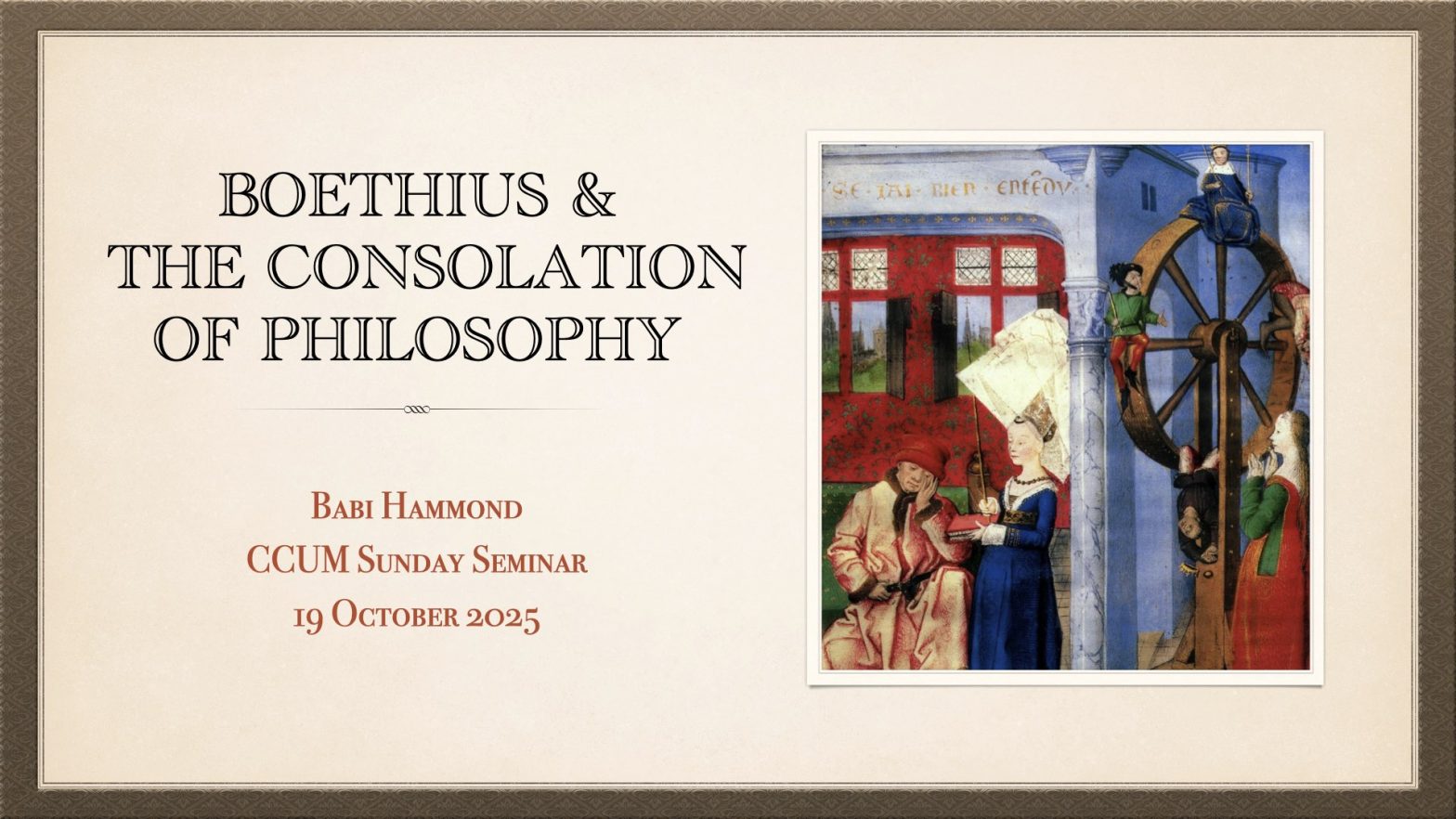
This talk today is about the late Roman, early medieval statesman, philosopher and scholar Boethius, and more particularly about his last work, a slim volume of prose and poetry called The Consolation of Philosophy that he wrote in 523 AD.
I should say at the outset that I have absolutely no warrant for giving this talk. I have never studied Medieval literature or philosophy, nor late Roman or Medieval history, beyond a few undergraduate survey courses many years ago. But I thought this little book, its author, and its historical context, was pretty interesting in itself, and I would love to hear your thoughts about it. And I also thought we might feel some camaraderie with Boethius as people living during a time when the world we have known seems to be falling apart.
Also, The Consolation of Philosophy deals with some big questions, on which this seminar likes to ruminate. So I invite you all, once again, to ruminate.
First I will give you a brief introduction to Boethius and his historical context. Then we’ll look into The Consolation of Philosophy.
Who Was Boethius?
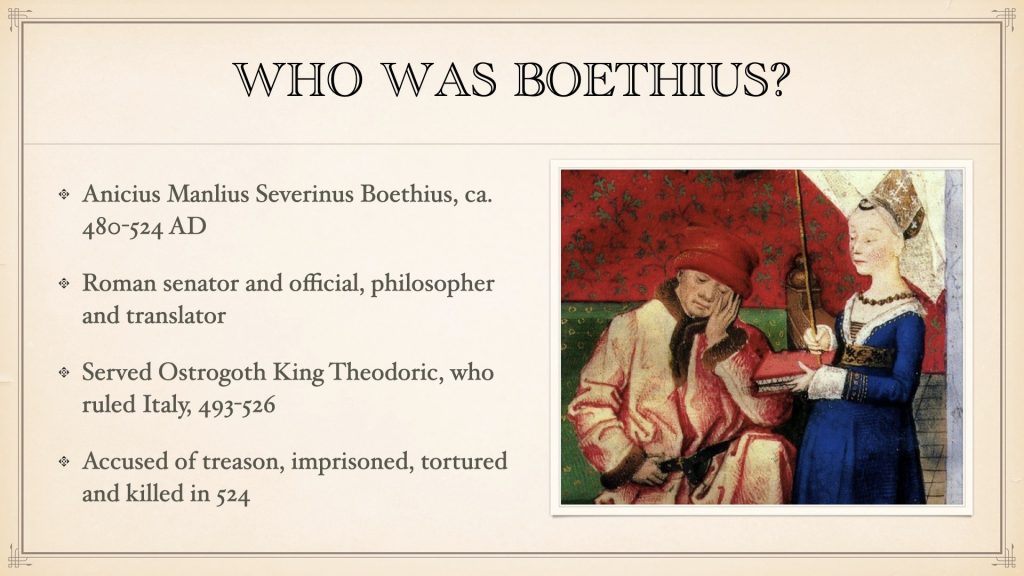
Boethius was born into very prestigious aristocratic family in 480 AD. His family had converted to Christianity fairly early, back in the 300s. His ancestors included two emperors and a pope. His father served as consul—a very high office in Roman political life—to king Odoacer in 487, but died when Boethius was still young. Boethius was then adopted into the family of another aristocratic family, and eventually married the daughter of his foster father.
Boethius thus received a top-notch education, and he proved himself to be a child prodigy and polymath who learned Greek very early; this was at a time when knowledge of Greek was already becoming increasingly rare in the remains of the Western Roman Empire.
As a scholar he dedicated himself to translating works of Aristotle, Plato, and other Greeks into Latin to help preserve them in the West; his translations and commentaries were one of the few sources for knowledge of Greek philosophy in the West until Renaissance scholars began recovering other texts in the 1300s. He also wrote treatises on Christian theology, music, and other topics.
He was inspired by Plato’s vision of a state run by philosopher kings and he entered public service under the Ostrogoth King Theodoric, who ruled Italy from 493 to 526. Boethius quickly rose to become Consul by 510, and he held other high offices under Theodoric. His crowning achievement, he says in The Consolation, was to see his two sons appointed joint Consuls in 522.
But, the very next year after this high honor, Boethius was accused of treason, arrested and confined—whether in a prison or, more likely, in some sort of house-arrest—in Pavia. And in 524 or 525 Boethius is tortured and executed. There are various accounts of his execution, some more gruesome than others, but that hardly matters here. Suffice to say that he was tortured and killed.
It is during Boethius’s imprisonment that he writes The Consolation of Philosophy. So the book is him, facing possible or probable torture and execution on what he maintains are false and maliciously motivated charges, consoling himself about what he has lost, and trying to recover a better sense of the meaning of his life even in the face of this calamity.

Boethius Timeline
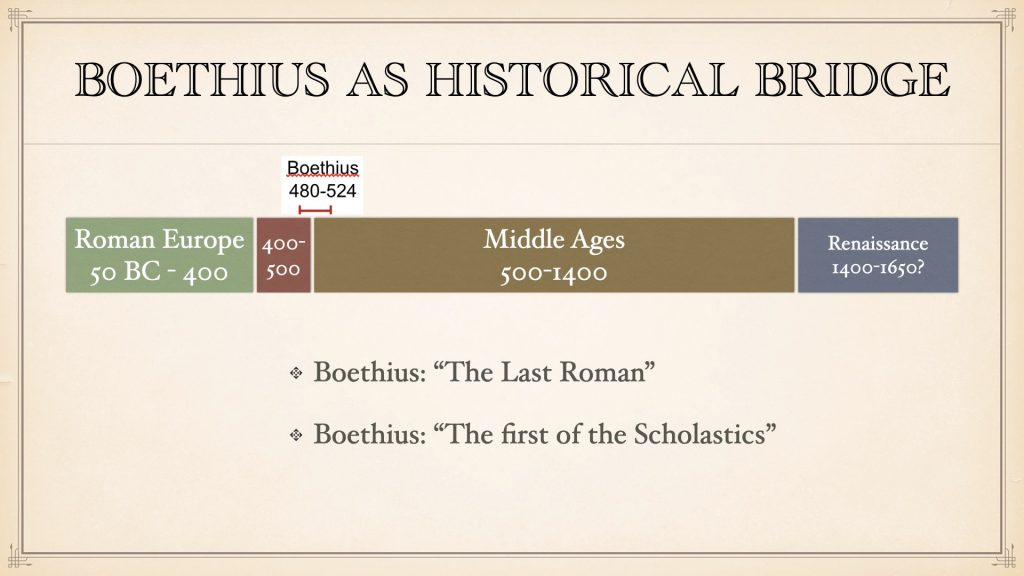
Just to orient ourselves to the context of Boethius’s life, here is a basic timeline of some important events. Boethius is living in a turbulent period of European history, in the aftermath of the fall of the Western Roman Empire.
476, just a few years before Boethius is born, is the commonly-accepted date for the final fall of the Western Roman Empire, when the Germanic ruler Odoacer deposes Romulus Augustus, the last Western Roman Emperor. Things had been going badly for Italy and the Western Empire for some time before that, though, so it’s not such a nice and tidy divide as the timeline might suggest. And even after Odoacer takes over, he and Theodoric, who kicks out Odoacer in 493, continue to use the Roman Senate and Roman government bureaucracy to rule, and at least nominally they accept titles as rulers on behalf of the Eastern Roman Emperor. So even though Italy has been taken over by these barbarian kings, there is still some continuity in Roman systems of government.
Christianity had been accepted in the Roman Empire for about 180 years by the time Boethius was born. Boethius himself wrote several theological works, and indeed by the time he is born paganism is being actively suppressed and it would have been impossible to serve in government without being a Christian.
So paganism at this time is decidedly on the outs, and knowledge of Greek is becoming increasingly rare in the West. Scrolls containing the works of Ancient Greek philosophers are crumbling, unread, in libraries and Boethius sees a need to translate these important works, even though they are 900 years old and non-Christian, into Latin so that they can help inform and educate the people and rulers of the now non-Roman, or perhaps only nominally Roman, West.
Boethius as Historical Bridge
Boethius lives at a historical break, then, between the “Ancient” Roman world and Medieval Europe, or Middle Ages. I don’t know if he himself saw this. The Western Empire had been falling apart for at least 100 years before Boethius was born, and even under barbarian rulers like Odoacer and Theodoric there were elements of continuity in the government.
It was probably not the case that Roman aristocrats left their villas one morning in 476 and said, “well, that’s the fall of the Roman Empire, then.” This periodization is all imposed hundreds of years later by historians trying to make some sense of it all, and to what extent these historical shifts were felt at the time is not something I can tell you.
But I think Boethius’s own effort to translate great works of Greek philosophers indicates that he felt something changing, and he wanted to do what he could to help preserve at least some of the knowledge from the old world to better serve the new one that was emerging. That’s only my supposition, though—I can’t point to a passage in Boethius’s own writing where he says that.
In any case, later scholars have described Boethius as a bridge—both the “Last of the Romans” and “First of the Scholastics,” heralding a type of scholarship that came into prominence about 600 years after him.

Slide 5: The Scholastics
The Scholastics were a group of Medieval scholars active around 1100 to 1400 who sought to reconcile Ancient Greek philosophy and physics with Christian doctrine. The Scholastics—again, a grouping and name imposed on them by later historians—included guys like Anselm of Canterbury, Peter Abelard, Albertus Magnus, William of Ockham, Thomas Aquinas.
Boethius might also be called a bridge between the two historical eras because his last work, The Consolation of Philosophy, was one of the most popular books of the Middle Ages and it was tremendously influential on guys like Chaucer, Dante, and a bunch of other Medieval and early Renaissance notables.
Slide 6: The Consolation
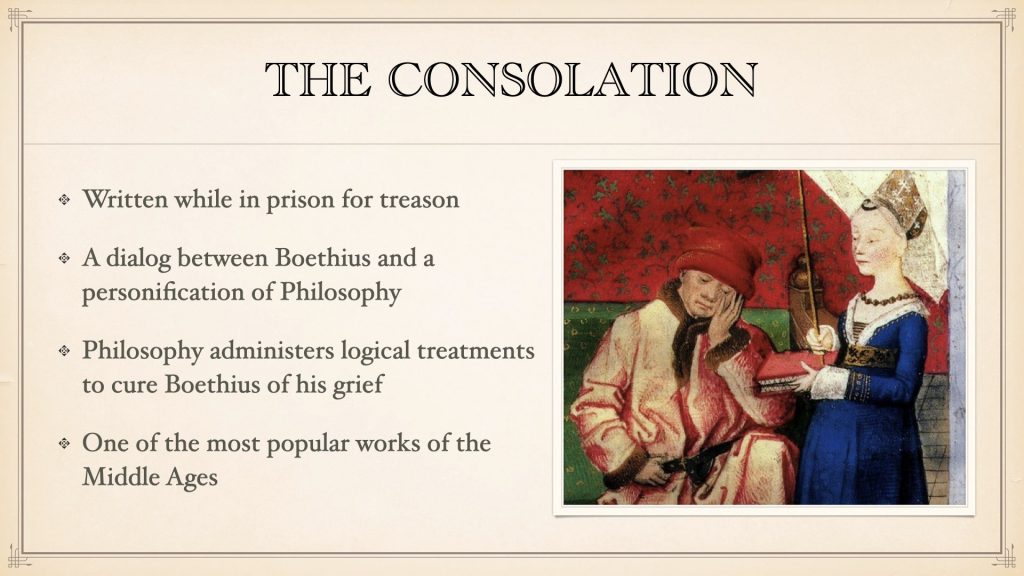
So, at last, let’s look at the The Consolation itself. It was written while Boethius was under arrest for treason. We don’t know the exact circumstances of his arrest. He was probably confined to a home in Pavia that was not his own, but he may have had access to books, and of course he must have had access to writing materials. So probably not some grim prison cell, but we don’t really know.
The book takes the form of dialogue between the imprisoned Boethius and a woman who is the personification of Philosophy, called “Lady Philosophy” in the text.
Lady Philosophy comes to Boethius while he is grieving over his unjust imprisonment. Philosophy administers “treatments” of logical arguments to remind Boethius of truths that he has apparently forgotten, as he’s moved away from his true self.
The text alternates between passages of prose dialog and sometimes densely argued logic and poems or songs, usually sung by Philosophy (though I think in at least one case Boethius recites some poetry). It was one of the most popular works of the Middle Ages and reflects in many ways the Medieval view of the cosmos, history, and fate.
Slide 7: C. S. Lewis on The Consolation
C. S. Lewis, the scholar of Medieval literature and (more famously) novelist and Christian popularizer, put The Consolation on his list of the ten books that had most influenced him, describing it as:
“for centuries one of the most influential books ever written in Latin. It was translated into Old High German, Italian, Spanish, and Greek; into French by Jean de Meung; into English by Alfred, Chaucer, Elizabeth I, and others. Until about two hundred years ago it would, I think, have been hard to find an educated man in any European country who did not love it. To acquire a taste for it is almost to become naturalised in the Middle Ages.”

Slide 8: Sample of the Consolation’s dialog
Just to give you a taste of the text, here’s a snippet of some of the dialogue. This is Lady Philosophy engaged in Socratic dialog with Boethius about predestination:
But for the sake of argument, so that you may see what follows, let us say that there is no foreknowledge. In this case, actions of the will are not forced to be predestined, are they?’
‘No.’
‘Again, let us say that there is foreknowledge, but that it does not impose any predestination on things; the same freedom of the will remains, I think, absolute and uninfringed.
‘But, you will say, even if it is not the same as predestination of the future, foreknowledge is a sign that the future will inevitably happen.
In this case, even if there were no foreknowledge, everyone would agree that the occurrence of the future is predestined, since signs represent what they denote but don’t cause it.‘So the first thing to do is to show that nothing happens other than of necessity, so that foreknowledge may be seen as a sign of this necessity; otherwise, if there is no necessity, that foreknowledge, too, cannot be a sign of something that does not exist…’
— Consolation, pp. 124-5
Slide 9: Poetry of The Consolation
That kind of almost syllogistic dialog is occasionally summed up by poems or songs like this one sung by Lady Philosophy. Some of these were made into actual songs during the Middle Ages, again attesting to the popularity of The Consolation during that time. This is just a couple stanzas of one poem. Most of them are at least twice as long.
O Thou who dost by everlasting reason rule,
Creator of the planets and the sky, who time
From timelessness dost bring, unchanging Mover,
No cause drove Thee to mould unstable matter, but
The form benign of highest good within Thee set.
All things Thou bringest forth from Thy high archetype:
Thou, height of beauty, in Thy mind the beauteous world
Dost bear, and in that ideal likeness shaping it,
Dost order perfect parts a perfect whole to frame. …— Consolation, p. 66
Slide 10: Lady Philosophy
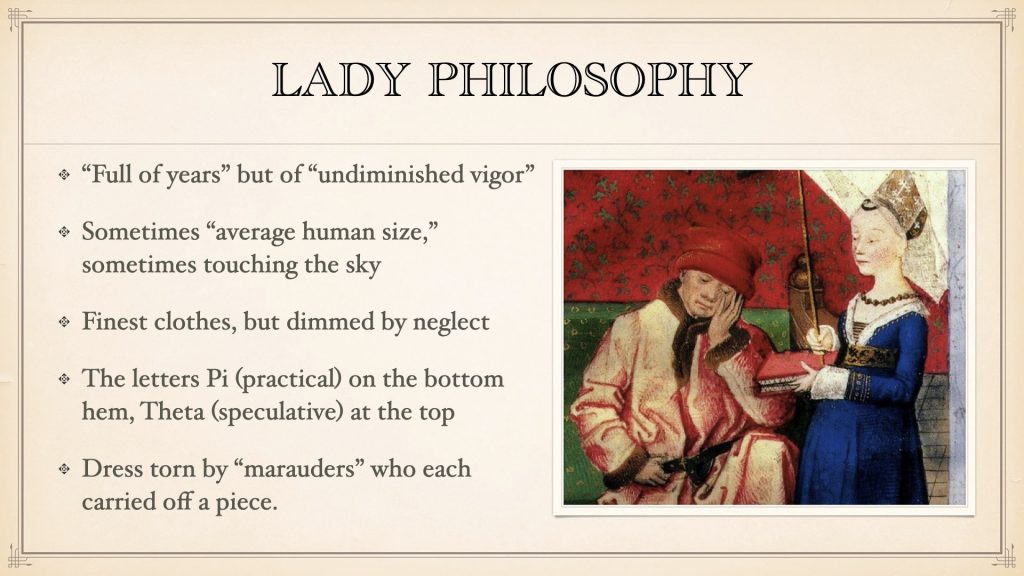
Lady Philosophy appears to Boethius in the book as woman both young and old, “full of years” but with “undiminished vigor” and shining eyes.
Her size seems to vary. At times she appears as a normal human, at other times she’s enormous, with her head seeming to touch the sky.
She’s dressed in very fine clothes, but they are kind of dusty from neglect.
The lower hem of her dress is adorned by the Greek letter Pi, which symbolizes Practical philosophy. A stair-like design connects the lower hem with the upper hem, decorated with the Greek letter Theta, for speculative philosophy.
Here and there small pieces of her dress have been torn away by “marauders,” symbolizing those schools of philosophy which have taken only a part of philosophy as truth, neglecting the more meaningful whole.
She’s carrying some books and a scepter, as shown in the picture here.
These attributes are all described early in the book, when Boethius first meets Lady Philosophy. After that, though, there is no mention of them. They just serve as symbols to establish some attributes of philosophy that Boethius must have felt were important, but they don’t come up again.

Slide 11: Philosophy Dispels the Muses
When Lady Philosophy first appears, Boethius is mourning his fate while the muses of Poetry surround him, encouraging his tears and his lamentations. Philosophy is having none of that moping about and dispels the muses, saying they have only “sweetened poisons” for “this sick man.”
Throughout the book Philosophy treats Boethius as a medical patient—a man suffering from an illness that has caused him to forget the wisdom he once knew. And Philosophy begins to treat her patient, first with mild palliative treatments or comforts, leading to up to stronger, more challenging, medicines. But these “treatments” are all logical arguments, asking Boethius about definitions and propositions and from his answers showing how reason leads incontrovertibly to certain (comforting, at least in the text) conclusions.

Slide 12: The Consolation’s Big Questions
The book deals with some big questions that will likely be familiar to this group, such as:
- Why do bad things happen to good people?
- What is true happiness?
- If God is omnipotent, why is there evil?
- If God knows everything, how can there be free will?
I can’t follow in detail all the arguments presented, but I want to give you at least a summary of what I think are Boethius’s (or Lady Philosophy’s) answers to these questions. They are all grounded in an Aristotelian or Neoplatonist world view and hopefully we’ll be able to talk a bit about that as well.

Slide 13: Why do bad things happen to good people?
Why do bad things happen to good people? This is the first thing dealt with by Lady Philosophy—the mild palliative meant just to rouse Boethius from his torpor of lament before they can move on to other, deeper, things. But it is also one of the things that was a very popular motif of the Middle Ages as they contemplated the variable nature of fate.
Slide 14: The Wheel of Fortune
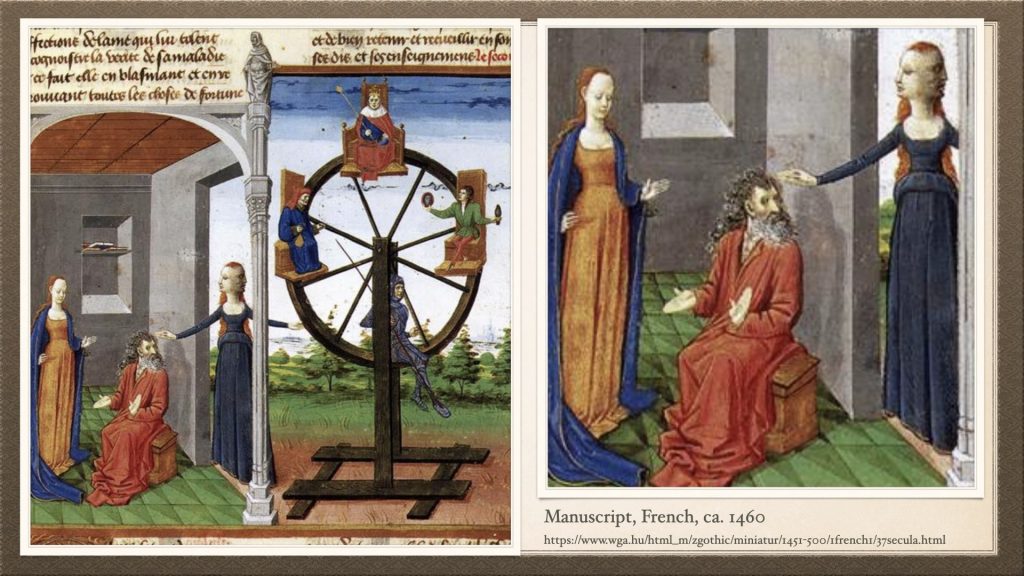
It’s all because of the The Wheel of Fortune, you see. No, not the silly gameshow once hosted by rightwing lunatic Pat Sajack, but the Rota Fortunæ, the symbol of capricious fate spun by Fortune to award or take away worldly power and wealth.

Slide 15: Boethius and the Wheel
Here, from a French illuminated manuscript from the 1460s, is a depiction of Boethius, with Lady Philosophy, on the left, and on the right Fortune spinning her wheel. At the top is what looks like a king—a guy with a crown and scepter, with someone on the way up and someone on the way down on the sides, and some poor bloke barely holding on at the bottom.
Slide 16: Two-faced Fortune
Here’s another depiction of Boethius and the Wheel of Fortune. This time Fortune looks a little more malevolent, as she has two faces—one fair and attractive, the other dark and ugly.

Slide 17: Two-faced and Blindfolded Fortune
And here Fortune is both two-faced and blindfolded. As she turns her wheel Prosperity and Hope help people go up, while Adversity, Pain, and Hate pull them down. Fortune also has many hands with which she awards crowns and titles or snatches them away.

Slide 18: Philosophy on Fortune
The first book of The Consolation has a fairly long, kind of whiny, recapitulation by Boethius of the wrongs done to him and how especially unfair it is because he only tried to act virtuously. Boethius is distraught that Fortune has abandoned him, and the high position and esteem he knew so recently have been taken from him. But this is just the nature of Fortune, Philosophy says:
you are wrong if you think Fortune has changed towards you. Change is her normal behavior, her true nature. In the very act of changing she has preserved her own particular kind of constancy towards you. … You have discovered the changing faces of the random goddess. … If you are trying to stop her wheel from turning, you are of all men the most obtuse.
The favors given out by Fortune were just those—favors—and they cannot be the basis of true happiness, Philosophy says. Anything given to you by others cannot be truly yours, because if it has been given it can just as easily be taken away. This ephemeral giving and taking is just what Fortune does, so don’t take it personally. You could have wealth and power one day, and the next day your whole family dies of the plague, or some barbarian horde invades and deposes you. It’s just the way the world works.

Slide 19: What Is True Happiness?
Well, if the things given to you by fortune cannot constitute true happiness, then what can? Men seek after wealth, power, fame, and bodily pleasures. But these cannot in themselves bring true happiness. The only true happiness is the one that is self sufficient.

Slide 20: Happiness & Self Sufficiency (1)
First, Lady Philosophy shows that true happiness and goodness, as both perfect and supreme, must therefore be one and the same thing. So in seeking happiness, men are also seeking goodness, though they may be confusing a mere part of happiness (wealth, power, etc.) for the whole, perfect, happiness.
Second, she shows that any form of happiness that is not self-sufficient cannot be true happiness or true goodness. For only if you have no wants can you be said to be self-sufficient, and that’s the same thing as true happiness.
So regardless of the form of worldly happiness men seek, they are really seeking self-sufficiency.
Slide 21: Happiness & Self Sufficiency (2)
But, by achieving a worldly, false, happiness, they are in fact making themselves less self-sufficient and therefore less happy. For example, if you have achieved wealth, you must therefore need others to help you protect your wealth. In order to achieve power and status, you must debase yourself to kings or other earthly powers higher than yourself, thus making yourself dependent on their goodwill.
These kinds of false happiness, therefore, are side-tracks that cannot bring you to the destination you’re really seeking.
The desire to seek true happiness is part of the nature of all creation, since everything made by God seeks its origin. Thus only in following your true nature, in seeking self-sufficiency / goodness / happiness in the unified form that is God, can there be true, perfect, happiness.
This form of happiness is eternal, and comes not from without but from following your true nature. Thus you can never be deprived of it. Or rather, you can only deprive yourself of it by forgetting your true nature and straying from the path of goodness and happiness.
Slide 22: Why is there evil?
So God, the “unmoved mover,” the power from which all things come and all things seek to return to, is the fixed mark above all things, is the true guide for all things in the world following their true nature.
But the greatest cause of my sadness is really this,” says Boethius at the start of Book IV, “the fact that in spite of a good helmsman to guide the world, evil can still exist and even pass unpunished. … [And] When wickedness rules and flourishes, not only does virtue go unrewarded, it is even trodden underfoot by the wicked and punished in the place of crime. That this can happen in the realm of an omniscient and omnipotent God who wills only good, is beyond perplexity and complaint.
Lady Philosophy replies: “It would indeed be a matter of infinite wonder, it would be something more horrible than any outrage, if, as you reckon, in the well-ordered house of so great a father the worthless vessels were looked after at the expense of the precious ones, which grew filthy. But it is not so.”

Slide 23: The Self-governing moral world
Because, Philosophy says, everything has a natural desire to return to the Creator, the source of all true good and happiness, the good are always strong and the wicked are always humbled and weak.” (85-6)
Those who do evil are acting against their true nature, thus turning away from true happiness and power. In doing so they therefore make themselves less happy, and less powerful, than those who remain virtuous.
The power and wealth that evil men possess on earth are only false substitutes, or superficial fulfillments of power and happiness.
The thrust of the argument here is that if you have will and power, you do what you really want. What all men really want is to turn to God, to do good and have virtue. But by not doing good they are showing that they have neither will nor power to act according to their true desire. Thus their evil is its own punishment.

Slide 24: Walking on your hands
Philosophy compares those who do evil to obtain happiness with those who do good by likening them to someone who walks on his hands versus someone who walks on his feet:
You will not deny that the action of walking is natural and human, will you? … If, then, one man is able to proceed on foot and goes walking, and another lacks the natural function of the feet and tries to walk on his hands, which may properly be considered the more able and powerful?’
— (Book IV, II, p. 89)
Conversely, the good who might suffer from the depredations of the evil, and who maintain their virtue, are demonstrating their greater power and will. Good deeds never lack reward in that they are themselves a reward, and bad deeds are always punished because they further alienate the wicked from their true desire.
Slide 25: Wicked are like animals
By falling from their true nature, men who are wicked are lowering themselves to non-human status, becoming more like animals than men.
You can say that someone who robs with violence and burns with greed is like a wolf. A wild and restless man who is forever exercising his tongue in lawsuits could be compared to a dog yapping. … So what happens is that when a man abandons goodness and ceases to be human, being unable to rise to a divine condition, he sinks to the level of being an animal.
Because by doing evil they are moving further from their true desire, punishment actually makes the wicked happier, helping to turn them toward the true end they are seeking.
Slide 26: Good is a reward unto itself
The good always receive reward because the highest reward is good itself.
If you have turned your mind to higher things, there is no need of a judge to award a prize; it is you yourself who have brought yourself to a more excellent state…” (Book IV, IV (p.99))
Something to notice here is that in this view God is non-interventionist. He’s set the world up in such a way that the wicked are always punished, and the good are always rewarded, just by the nature creation. God doesn’t have to reach down and smite someone, or lift someone up out of the mud. Instead all the rewards and punishments are just built into the system. It’s how the world works, even if to mere mortals it might seem otherwise.
Slide 27: Is there free will?
This question is dealt with in the last book of The Consolation, and the argument here gets (for me, at least) pretty hard to follow. But essentially the question is, given that God knows everything, the past and the future, and that if God knows something it must surely be true, then how can there be such a thing as free will?
Slide 28: Free will
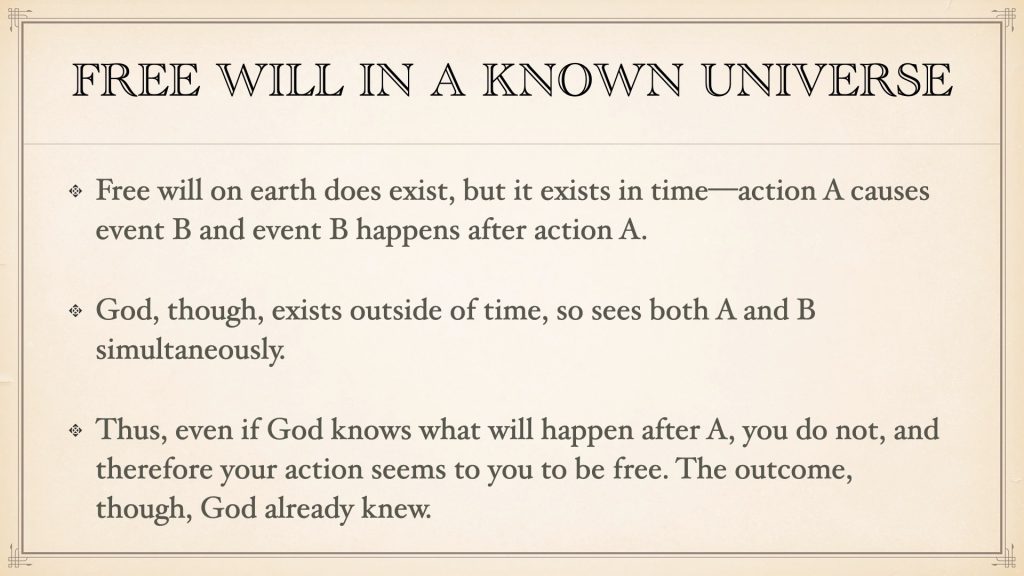
Philosophy’s answer to Boethius is that events for humans happen in time: A causes B, and so A happens before B. For humans there is no necessity to do A or to have outcome B. It’s a product of individual will and what appears to humans to be happenstance.
God, though, exists on a higher plane, one beyond time. Thus God sees both the past and the future as the present. Philosophy says:
God sees those future events which happen of free will as present events, so that these things when considered with reference to God’s sight of them do happen necessarily… but when considered in themselves they do not lose the absolute freedom of their nature.
— (Book V, VI, p. 135-6)

Slide 29: Larger themes and thoughts
So that’s my probably rather crude summary of The Consolation of Philosophy. I don’t know if you feel that you’ve been ‘naturalised in the Middle Ages,’ as C. S. Lewis thought you might if you acquired a taste for it. But maybe at least you’ve gotten a tourist visa or perused a couple travel brochures.
I want to conclude by discussing some of the larger themes of the book and how they reflect the Medieval view of the world, and what, if anything, The Consolation might tell us about how to live a good life in the midst of a period of historic transition. Like, say, what is a good person to do if a bunch of barbarians has taken over your government and what you thought you could take for granted about truth and justice and the path of history no longer seemed assured. Just hypothetically, you know.
So first, some more meta or scholarly issues: You might have noticed that there is nothing explicitly Christian in The Consolation. It doesn’t mention Christ, the apostles, or the Church. It doesn’t say anything about sin or the wrath of God, or forgiveness. It has one subtle mention of a phrase that hearkens back to a verse in the Book of Wisdom, which I guess is part of the Catholic Bible but regarded by most Protestants as part of the apocrypha. But that’s about it.
Some scholars have said Boethius wasn’t a true Christian, or that, faced with arrest and possible execution, he lost his Christian faith and turned instead toward paganism.
There are also some scholars who think Boethius was being very clever in The Consolation, and that it was actually intended to be read ironically, as showing the insufficiency of Philosophy to answer those big questions without the Bible and Christian faith.
The literary form of The Consolation is a ‘Menippean satire,’ which was often used to poke fun at the pretensions of authority figures. Boethius surely knew this and probably would have chosen this form intentionally. Furthermore there are, according to the article about Boethius in the Stanford Encyclopedia of Philosophy, some logical fallacies in the book that, some say, might be intended to show the limitations of Philosophy. I could not follow the logic of this view, at least as it is presented in the Encyclopedia, so I will just refer you there if you’re interested.
This, to me, seems plausible, but regardless it was probably not how The Consolation was read—and is read—by most people. The book was, as I’ve said, hugely popular in the Middle Ages and very influential among many people not known for their weak Christianity or lack of philosophical acumen. Certainly C. S. Lewis, very Christian Medieval scholar that he was, loved the book. I think it’s safe to say, then, that even if Boethius intended it to be read ironically, most of his readers took it at face value.
When asked about the lack of Christianity in the book. C. S. Lewis replied that the answer was right there in the title: It was about Philosophy, not religion, even if both might essentially arrive at similar conclusions. Lewis also, by the way, thought that the tone of the book indicated that Boethius was unaware of the seriousness of his position. In the book he mourns his loss of his government positions and friends. He might not have been aware that he was going to be tortured and executed, even though that is what actually happened to him.
Another way to reconcile the philosophy of the book and its lack of explicit Christianity is by looking at it through the lens of the Medieval view of the cosmos. This is an Aristotelian / Neoplatonist view, where everything in the world is an imperfect copy of some more perfect thing that existed before it, culminating in the perfect things that exist on a higher plane, in the mind of God.
This was a view shared by the Medieval Scholastics, who sought to reconcile Greek philosophy with Christian doctrine. The basic idea was that the older something was, the less degraded it was compared to the less perfect forms of the current day. Thus Greek Philosophy—900 years old for Boethius—had caché. Since they knew that Christian doctrine must also be true, then the two things must share a common origin and through intense study into their mysteries the two bodies of knowledge could be reconciled. They shared the same origin, and were both aspects of the single, beautiful, gown of philosophy.
Finally, I wanted to talk about what The Consolation might offer us today, as we inhabit an era that feels like the end of something and the beginning of something else that might be significantly worse.
In the Medieval cosmos, as I said, the earthly future was ruled by fickle fortune. Only by focusing on more eternal things than the events of the degraded world, and acting in accord with that more eternal nature, could you ensure your happiness and virtue.
Today, of course, we have a more progressivist view of historical change. “The arc of history is long, but it bends toward justice,” in the phrase of some unknown 19th century clergyman that I often hear in encouragements to keep hope and keep working. We expect, by patient application of our civic virtue, that the world will get better, if not for us than for generations to come (but probably for us, too). I wonder what Boethius might have said about that?
C. S. Lewis, to bring him up once again, happily considered himself a dinosaur—a relic of the Medieval past. He was once asked to write an essay on how to live in an atomic age. This was in 1948, and people were worried that The Bomb would lead to the end of human civilization (as, indeed, it still could).
So: How are we to live in an atomic age? Lewis replied:
Why, as you would have lived in the sixteenth century when the plague visited London almost every year, or as you would have lived in a Viking age when raiders from Scandinavia might land and cut your throat any night; or indeed, as you are already living in an age of cancer, an age of syphilis, an age of paralysis, an age of air raids, an age of railway accidents, an age of motor accidents. … In other words, do not let us begin by exaggerating the novelty of our situation. …
This is the first point to be made: and the first action to be taken is to pull ourselves together. If we are all going to be destroyed by an atomic bomb, let that bomb when it comes find us doing sensible and human things: praying, working, teaching, reading, listening to music, bathing the children, playing tennis, chatting to our friends over a pint and a game of darts—not huddled together like frightened sheep and thinking about bombs. They may break our bodies (a microbe can do that) but they need not dominate our minds.
I like that a lot. But then Lewis goes on to explain that what happens in this world is not important compared to what happens to your eternal soul, and I find it more difficult to follow him there. Surely you must do both—care for the world and care for your soul, whether it’s eternal or not. Or maybe that difference is false, and in doing good for one you are of necessity doing good for the other.
Thank you very much for listening to this talk, and I would love to hear your comments or questions.