

Since we arrived in Taipei, I have spent a lot of time pondering trash.
At nearly every apartment I viewed in Taipei (thanks to the misadventures I chronicled in this earlier post and this one, I saw something like twelve altogether), the landlord described in detail the building’s system for garbage disposal. Often they actually walked me to a garbage-and-recycling area in the basement to show off the dumpsters: how clearly labeled they were, how easy to use. At the first apartment we lived in the building cleaner drew me aside repeatedly to correct my disposal technique (I like to think that she was giving me a more refined level of instruction each time as I gradually caught on to the system, but I suspect that I just kept making the same mistakes).
I have had many conversations about trash with acquaintances both Taiwanese and international; I have spent hours, no exaggeration, trying to find authoritative information about how to dispose of recycling and kitchen waste; at one point I read through the Taipei City Government Environmental Protection Bureau’s website and handwrote a translation of their recycling rules to stick on our fridge.

If you could audit my brain’s energy use over the last couple of months like you can audit your phone’s battery use, the highest energy-consuming tasks would probably be something like this, in order:
*Where to live
*What to eat
*Trash and recycling
*(…somewhere down the line:) Research and writing
By now you may be wondering what is wrong with me, what strange configuration of my psyche compels me to be so obsessive about this most ordinary activity, or what peculiar defect makes me so bad at such a simple task. But it’s not just me. If you live in Taipei, you cannot not think about trash. Dealing with trash is a high-priority collective project here.
Taiwan, many websites are quick to tell you, has one of the highest recycling rates in the world. Some say it ranks second only to Germany in its “effective recycling rate.” According to this article from 2017, “Taiwan citizens produce an average of 0.4 kg of waste per day, down from 1.14 kg two decades ago, and far below today’s global average of 1.2 kg per person.” (this article says the US average is a little over 2 kg/person/day, if you’re wondering) That’s a pretty significant turnaround for a country that just a few decades ago used to bear the nickname “Garbage Island” as its landfills started to burst at the seams.
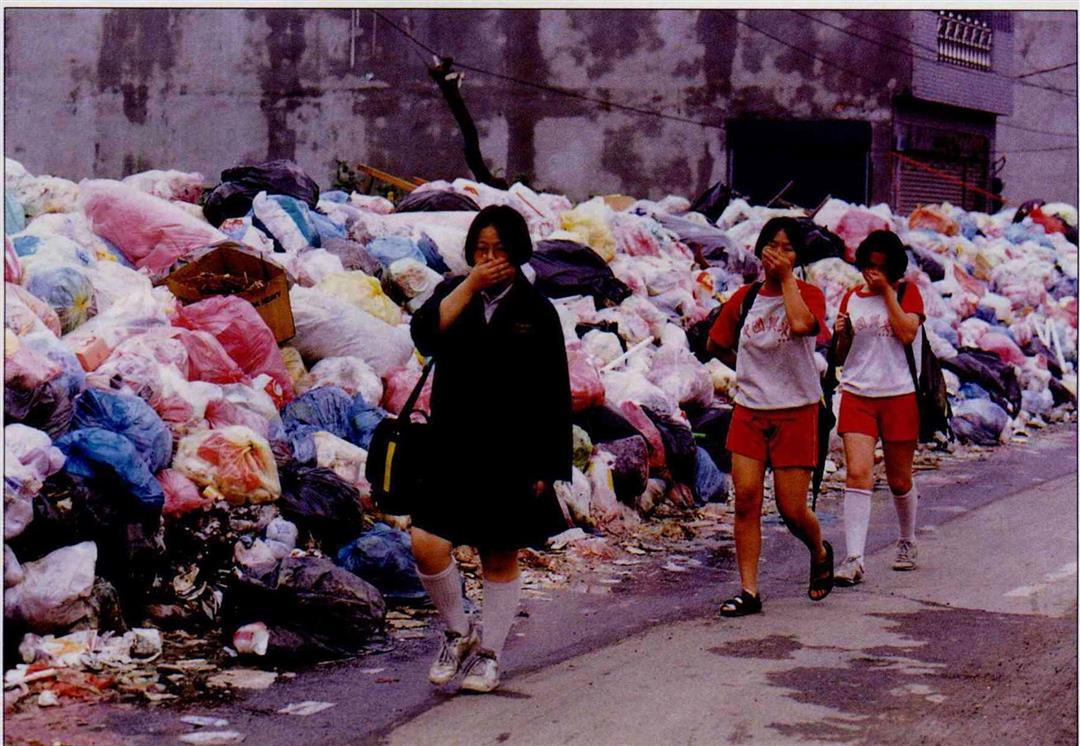
Having lived in the PRC in the late 1990s, I feel I know what that Taiwan might have been like when it earned that epithet. One of the first things that struck me about Dalian, the otherwise-beautiful coastal city where I taught English, was how trashy it was. China was still adjusting to a newly booming economy that pumped out lots and lots of cheap, disposable items, and its system for dealing with that tidal wave of throwaway stuff had clearly been overwhelmed. There were trash bags in the trees, and not just the occasional one in the occasional tree—I remember multiple bags being tethered in each crown, like oversized fruit. Bags and piles were discarded by the side of the road, and any low place in the topography would have its little reservoir of wrappers and containers and chopsticks and other junk that had tumbled or been blown down from higher, flatter resting places. The university where I taught backed onto a lovely mountain, but when you climbed it you saw litter everywhere: old clothes, plastic toys, cigarettes, but mostly lots and lots of wrappers, bags, and napkins. So anyway, apparently Taiwan had a similar problem back in the day. But they’ve since cleaned it up remarkably well.
When in my frenzied searches for reliable information I first came across the claim about Taiwan’s world-leading recycling, I was flummoxed. How on earth do they manage that when their system is so byzantine? I thought. I have since come to believe, however, that the complexity of Taiwan’s trash and recycling system—its maddening all-consuming quality—is actually a feature, not a bug. To help you understand what I mean, let me briefly sketch the contours of Taipei’s trash ecosystem, at least as I understand it.
When it comes to trash, there are basically two different kinds of apartments in the city.
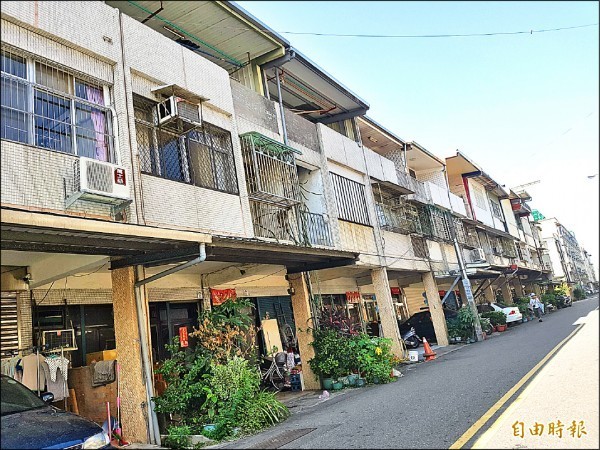
If you live in a tòutiāncuò 透天厝, a row house like the ones pictured below, you’re responsible for taking your own trash out to the truck when it comes.
That’s the key: when it comes. You can’t just plop your bins out on the curb in the morning and bring them in when you get home from work. Garbage trucks prowl the city streets from midafternoon to relatively late at night. Unlike in Denver—where they intrude on your consciousness only when you’re stuck behind one in your car or you hear one pulling away from your house when you forgot to put out your bin (sigh)—here they are part of your daily soundtrack. Garbage trucks in Taipei loudly play Beethoven to let the neighborhood know they’ve arrived. Bagatelle No. 25 in A Minor, “Garbage Processional,” (more commonly known as “Für Elise”) resounds for several blocks around each truck. They don’t play it continuously—that really would be a kind of torture—but often, in short bursts. It’s so ubiquitous that I may have started hearing it even when it’s not playing. The other night as I was walking home I had to stop and collect myself when I realized that I was definitely hearing Für Elise oh-so-faintly but I couldn’t ascertain whether it was coming from outside or inside my head. According to one of my conversation partners, some years ago the authorities decided to stop having the garbage trucks blast music on the grounds that it was a kind of noise pollution that disrupted citizens’ lives. But there was such an outcry as people missed their pickups and garbage began to pile up in their homes that the government restored the music.
Here is a link to a video of a Taipei garbage truck playing its song.
So if you live in a tòutiāncuò, when you hear the strains of Für Elise, you have maybe ten minutes to get your bags together and hustle out to the neighborhood pickup spot. If you get home late or you’re in a meeting or the shower and you don’t get out there when the trash trucks arrive, you’re out of luck. You will be living with your trash until the next pickup. Fortunately for you, the pickups are frequent—twice a day most days, once roughly around quitting time (5 pm-ish) and once later in the evening (9 pm-ish).
The garbage truck is accompanied by a smaller truck that picks up recycling and kitchen waste. Not everything is picked up every day—in Taipei, Tuesdays, Thursdays and Saturdays are for recycling “three-dimensional” things (bottles and cans, bento boxes, paper cups, Styrofoam, aluminum foil, milk and other drink cartons, etc), while Mondays and Fridays are for “flat things” (wastepaper; all shapes of paper boxes—flattened, of course; newspapers; paper bags; plastic bags; etc.). “Other” things, including lamps, batteries, waste oil, and kitchen waste, are accepted every day except Wednesdays and Sundays. Kitchen waste needs to be separated into stuff that can be composted and stuff suitable for pigs to eat. You’re starting to get a sense, I hope, of how this drains the mental batteries. I’m not sure which days you can recycle those.
If you live in a dàlóu 大樓, a tall multistory apartment building with a security guard at the entrance, you usually have a designated garbage-and-recycling space where you can leave your waste at your own convenience, without having to keep an ear out for trash music. That’s the kind of building we live in. Ours looks like this:

This is definitely less stressful than having to meet the garbage truck in the street, but it doesn’t eliminate trash stress altogether. The communal garbage area is one of the most confusing and sensitive areas of the complex. It is kept locked and is replete with signs instructing you what to do and not do and other signs warning you of the penalties for violating the instructions on the first set of signs. Here is a non-comprehensive sampling of the signs in our building’s garbage area:
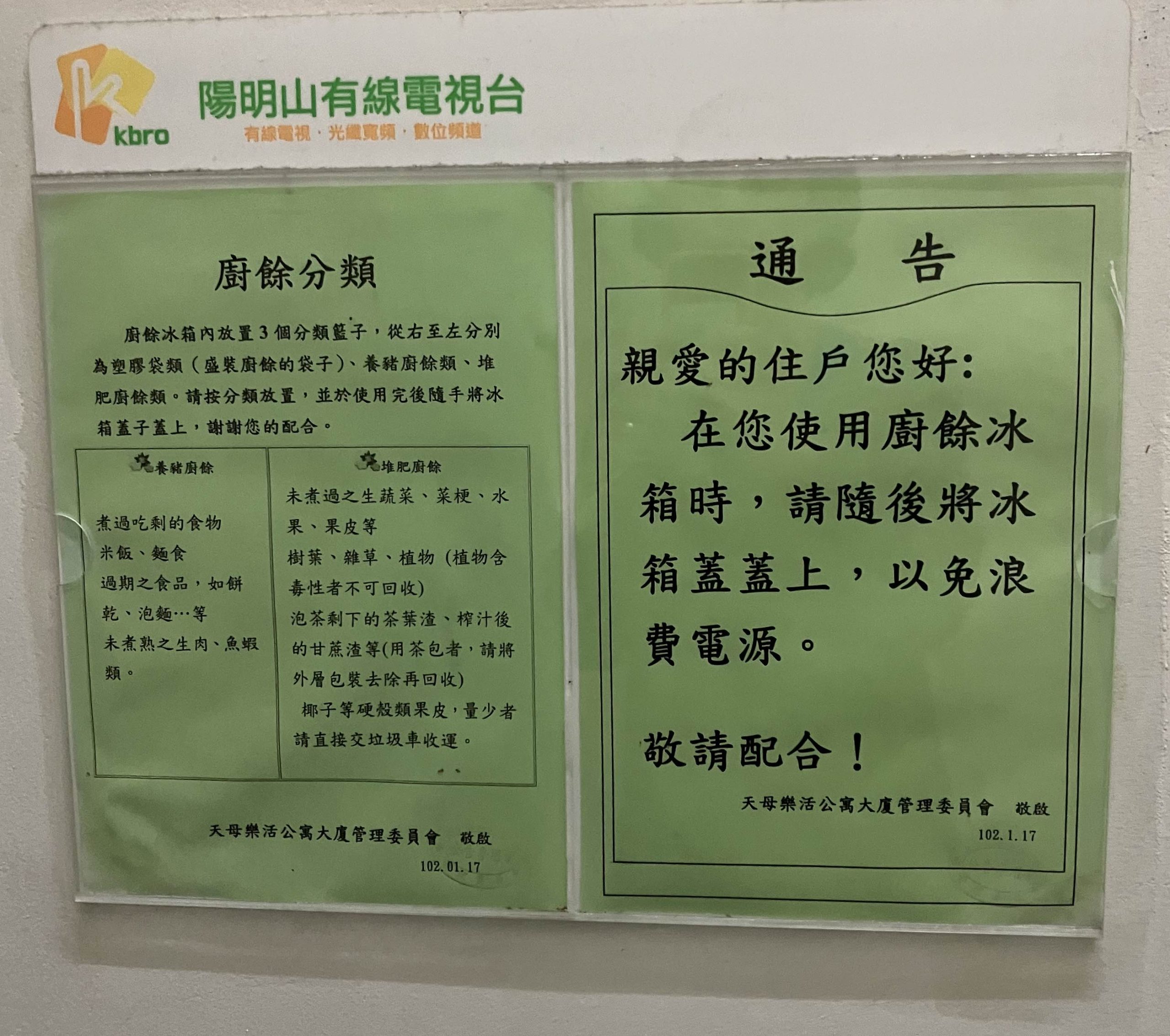

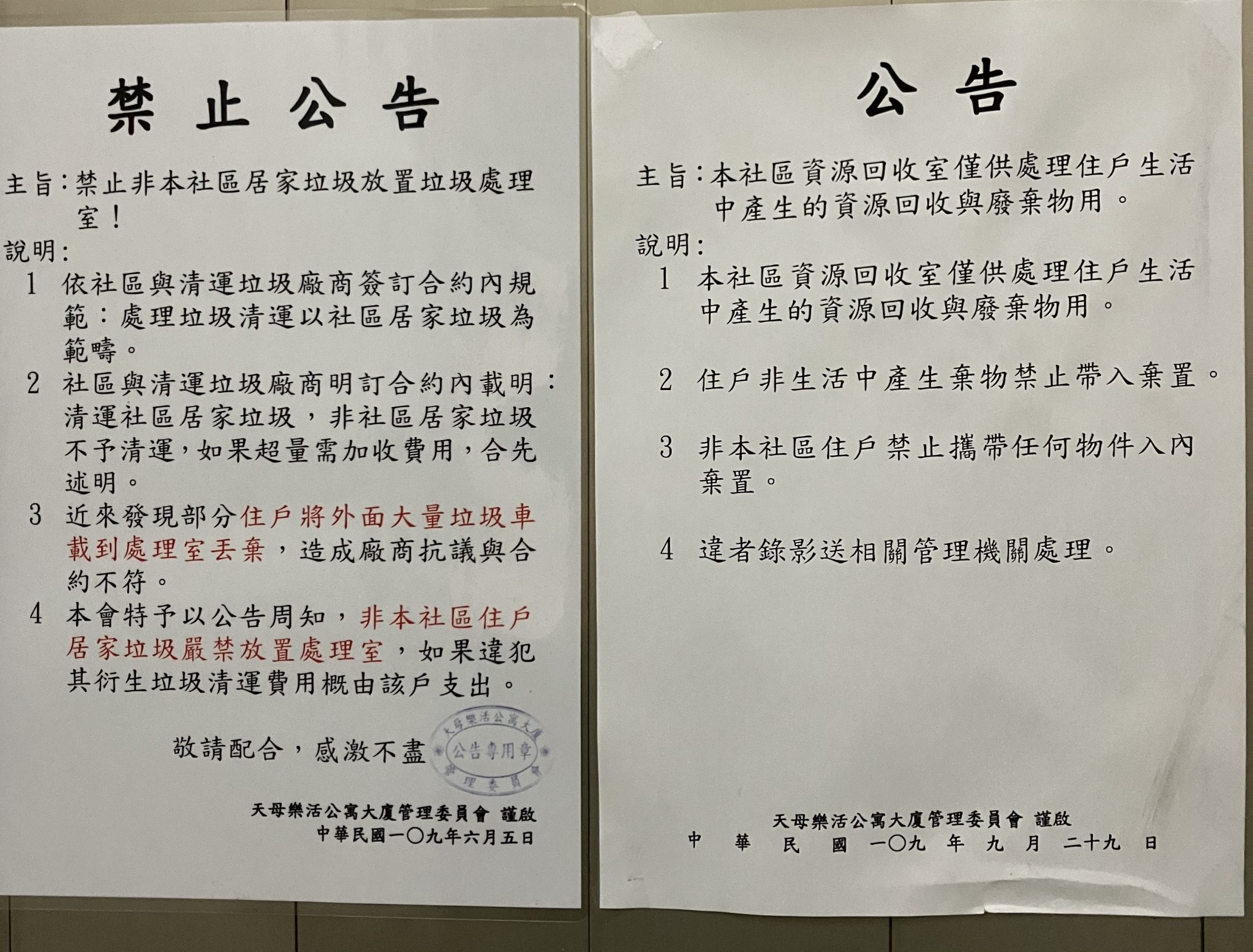
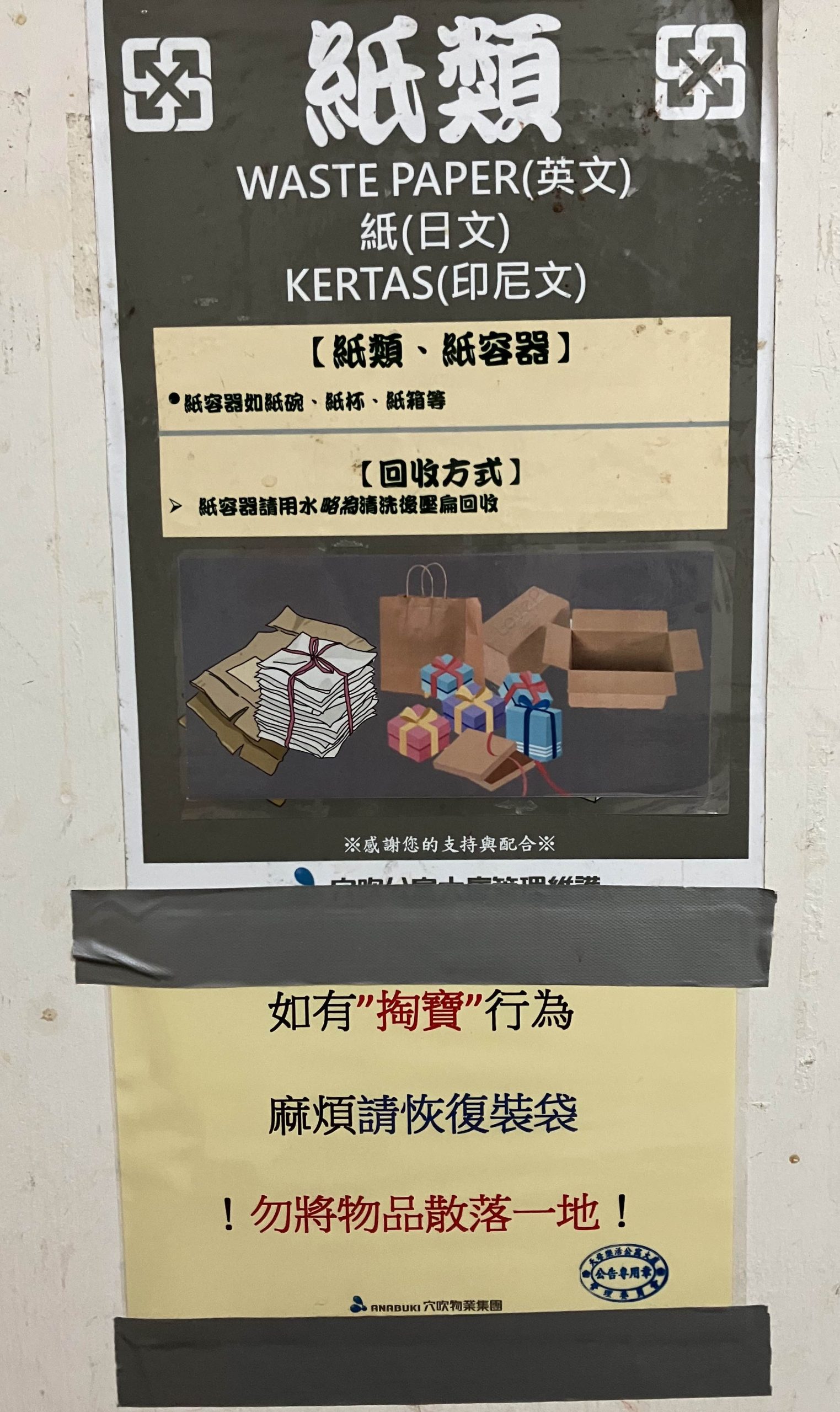
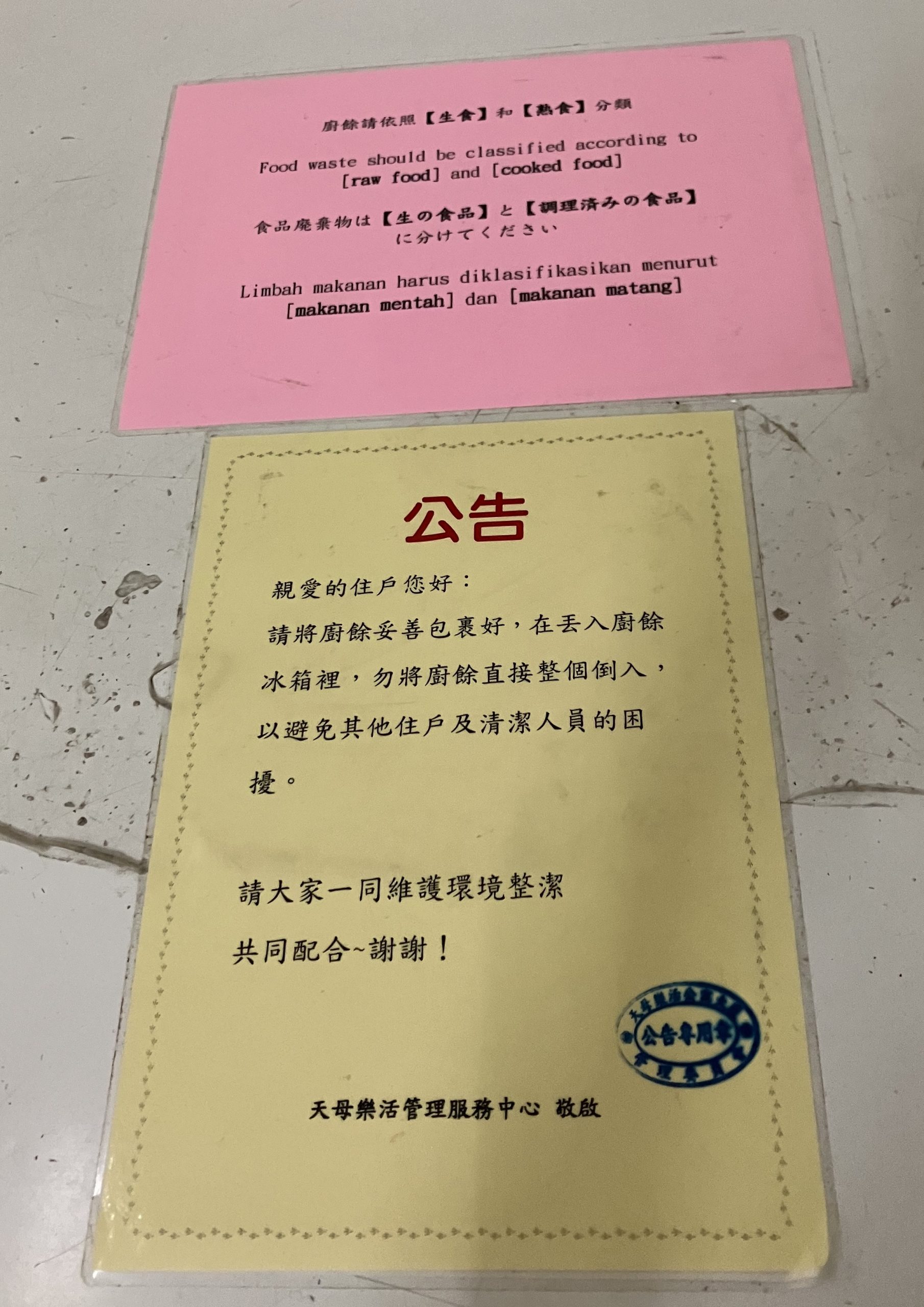
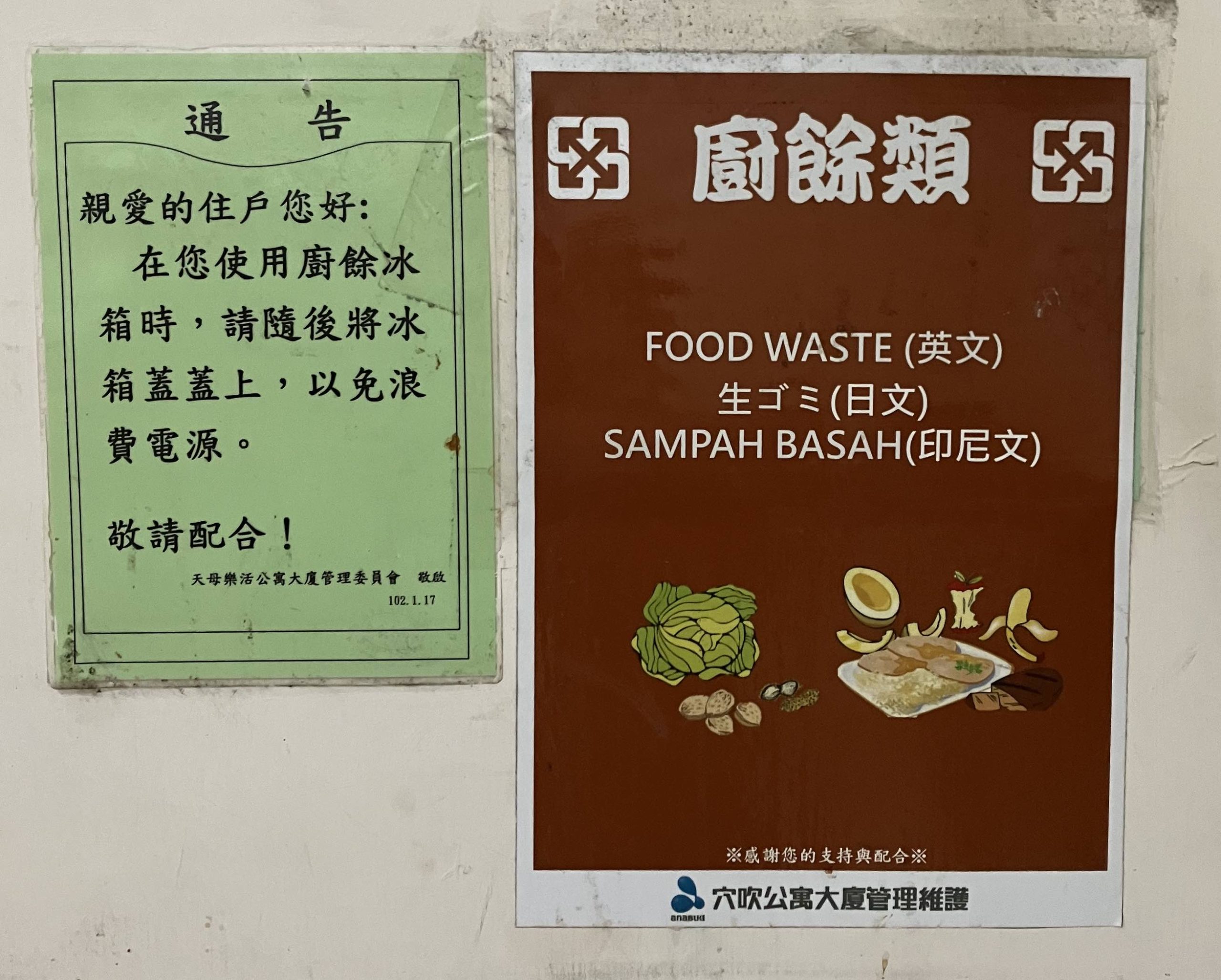
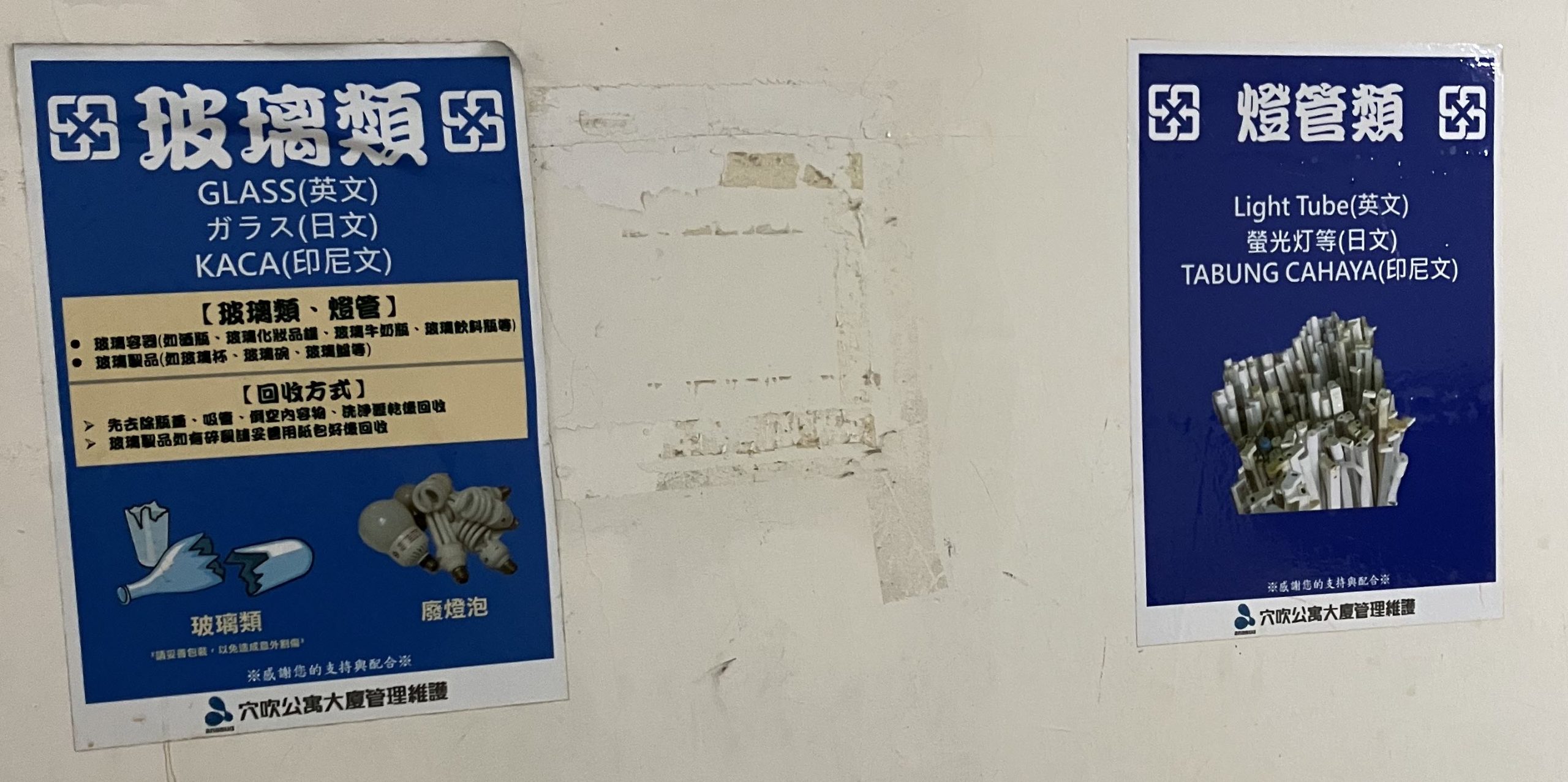
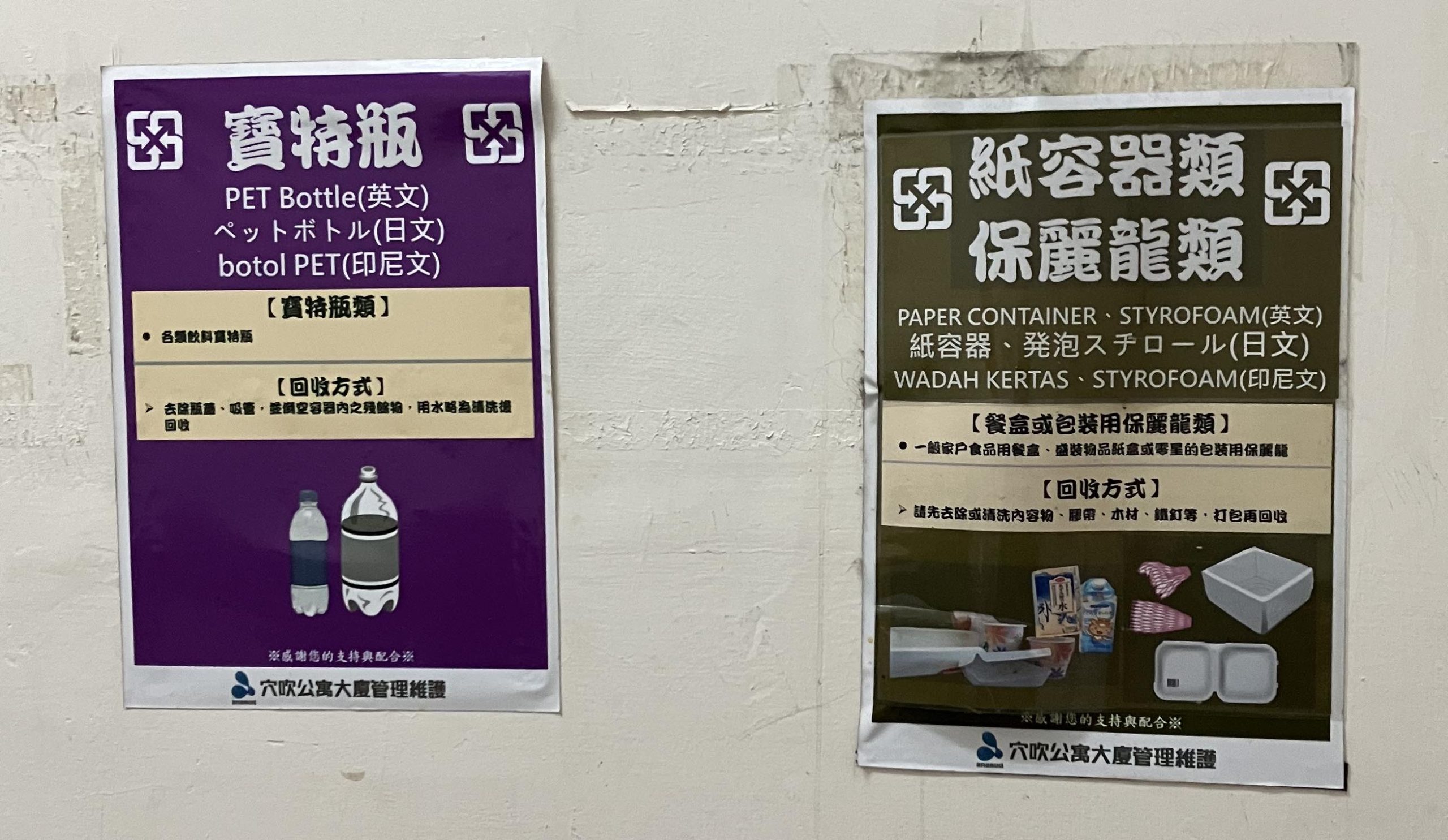

One of the first signs is a warning to anyone who does not live here that they are not allowed to dump their trash in the community bins, and to anyone who does live here that they’re not allowed to bring in outside trash (from their office, for example, or another apartment) and dump it here. This trash area is only for trash generated in this apartment complex by residents of this apartment complex. The signs remind anyone who is tempted to violate this or any other trash rule that the area is under video surveillance. What happens to a garbage scofflaw? Public shaming, for one thing: below is a photograph currently displayed in the apartment elevators, a screen grab from the surveillance footage showing our neighbors leaving a washing machine and some branches in the trash area.

“It is forbidden to dispose of large washing machines in garbage dumps,” and “It is forbidden to dispose of large bags of branches,” the flyer reminds us in Chinese, Japanese, and English, the native languages of most of the residents of this complex. Fair enough—it is pretty poor to dump your washing machine in the communal trash.
But what about the subtler rules, like how you’re supposed to separate out your recycling and kitchen waste? Recycling and kitchen waste are sorted as finely here as they are at the trucks, and I still don’t feel like I’m getting it right. There are separate bins for plastic bottles, flat paper, food containers, glass, Styrofoam, metal cans, light bulbs, and some other things that I’ve forgotten. The signs on the bins don’t always match the signs above the bins, so when you look in a bin to make sure it’s the right one for the particular item you have in hand, it’s sometimes a mishmash of two different kinds of recycling. Kitchen waste goes in a big top-loading freezer to keep the smell down. Bafflingly, there are three containers in the freezer, even though the Taipei City Department of Environmental Protection only identifies two different categories of kitchen waste (pig feed and compost). A sign outside the trash room explains that from right to left, the freezer containers are for “kitchen waste stuffed in plastic bags,” “kitchen waste suitable for pig feed,” and “kitchen waste suitable for compost.” But the signs inside the lid of the freezer say that one side is for cooked food waste and the other side is for raw food waste (two categories, not three, and nothing about pigs).
Here are a couple of “quick and easy” graphic guides that New Taipei City has published to get people up to speed on sorting their trash and recycling (we live in Taipei City proper; New Taipei City is the area surrounding it):


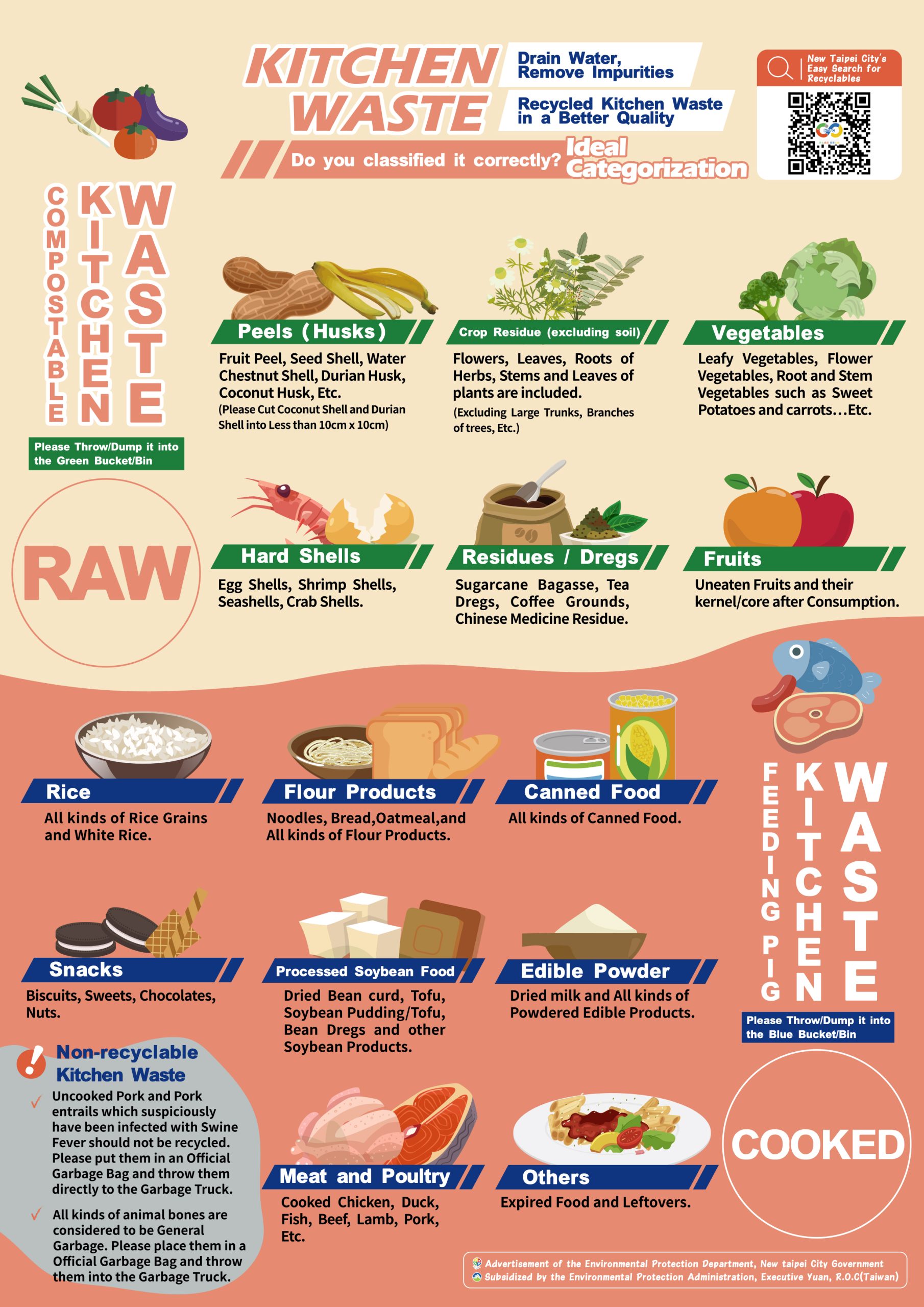
If you live in Denver, where we have just two bins (one for trash, one for recycling—or three if you pay extra for a compost barrel), this may not seem so quick and easy. It doesn’t seem that way to people in Taiwan, either. One of my conversation partners tried to help me figure out how to sort my recycling by looking up Taipei City recycling categories online while we were chatting. “Tian,” (“Oh my god,”) she exclaimed, “There are eighteen?” Yep, something like that. It seems to be the opposite approach to recycling in the US, where the impulse has been to make recycling as simple as possible in hopes that people will actually do it.
How, then, does this island manage to pull off such an exceptional recycling rate? Why don’t people just give up and throw everything in the trash? Partly, I think, because your trash habits are under constant surveillance. If you’re a tòutiāncuò dweller, the garbage workers watch you put your trash and recycling in the trucks, and presumably they will correct you if you’re not doing it right. As I mentioned, in the dàlóus that we’ve lived in, the cleaner took me to task for not adequately separating and preparing my recycling. And of course no one wants a photograph of themselves breaking the rules to appear in the community elevator.
For the people who live in the row houses, taking out the trash is also a kind of community-building activity. I’ve seen neighbors greeting neighbors, a bag of pig feed in one hand and regular trash in the other, striking up conversations on their way to the trucks. Here are some pictures/videos I took on a rainy evening the other day of people in my neighborhood waiting for the approaching garbage trucks and then taking their trash to the trucks once they arrived.*

But there’s also something about the burdensome nature of the task that, perversely, makes it a higher priority. Having to keep track of more than half a dozen categories of waste, and being responsible for properly preparing them (flattening boxes, cleaning food waste off of paper packaging, removing labels from bottles, separating plastic windows from paper bags) has made me more aware of the kinds and amounts of disposable stuff I’m consuming every day, and definitely makes me wants to produce less waste. Considering that the amount of trash I produce is one of the biggest and most measurable ways I impact the material world around me, it seems appropriate to have to devote some time every day to figuring out what to do with it. Maybe making it easy makes people complacent, allowing them to imagine that the waste problem has been sorted. I know that I have been even more annoyed and frustrated over the past few months as I’ve separated out the plastic into its appropriate categories and thought about reports that plastic actually isn’t really recyclable in most cases. Now when I’m in the grocery store I look down the aisle and envision in my mind which bins all that packaging is going to end up in. The Taiwan EPA official in this nice Smithsonian piece confirms that that’s exactly the kind of attitude they’re trying to cultivate: “For a policy like this to work, you have to make each one responsible for his personal consumption. You need waste disposal to sit firmly in the public consciousness.”
Mission accomplished, sir: I have never lived in a place where waste disposal sat more firmly in people’s minds. Even in Dalian back in the 1990s, when we were wading through refuse every time we went outside, no one really thought of it as their responsibility. One of my fellow teachers and I decided to organize a “clean up the mountain” day where we’d take our students on a hike and everyone would take trash bags and fill them up as we went along. When we proposed this to my students, they stared at us in perplexed silence. “But that’s not our trash,” one finally said, implying: so why should we clean it up? Taiwan, at least in recent years, has tried to make garbage everyone’s concern.
*The first episode of The Jennie Show (linked here), a cartoon show about a girl from Colorado who’s moved to Taipei, captures this neighborhood/community effort feeling well. It’s only about 3 minutes long and fun to watch.
They say one man’s trash is another’s treasure. Your essay on trash is a treasure. Thanks.