
Sorry I haven’t posted in a while! I’ve been working intensively on the book manuscript lately and that’s absorbed most of my writing time and energy. Here’s a post I’ve had lingering in my file but hadn’t quite finished…
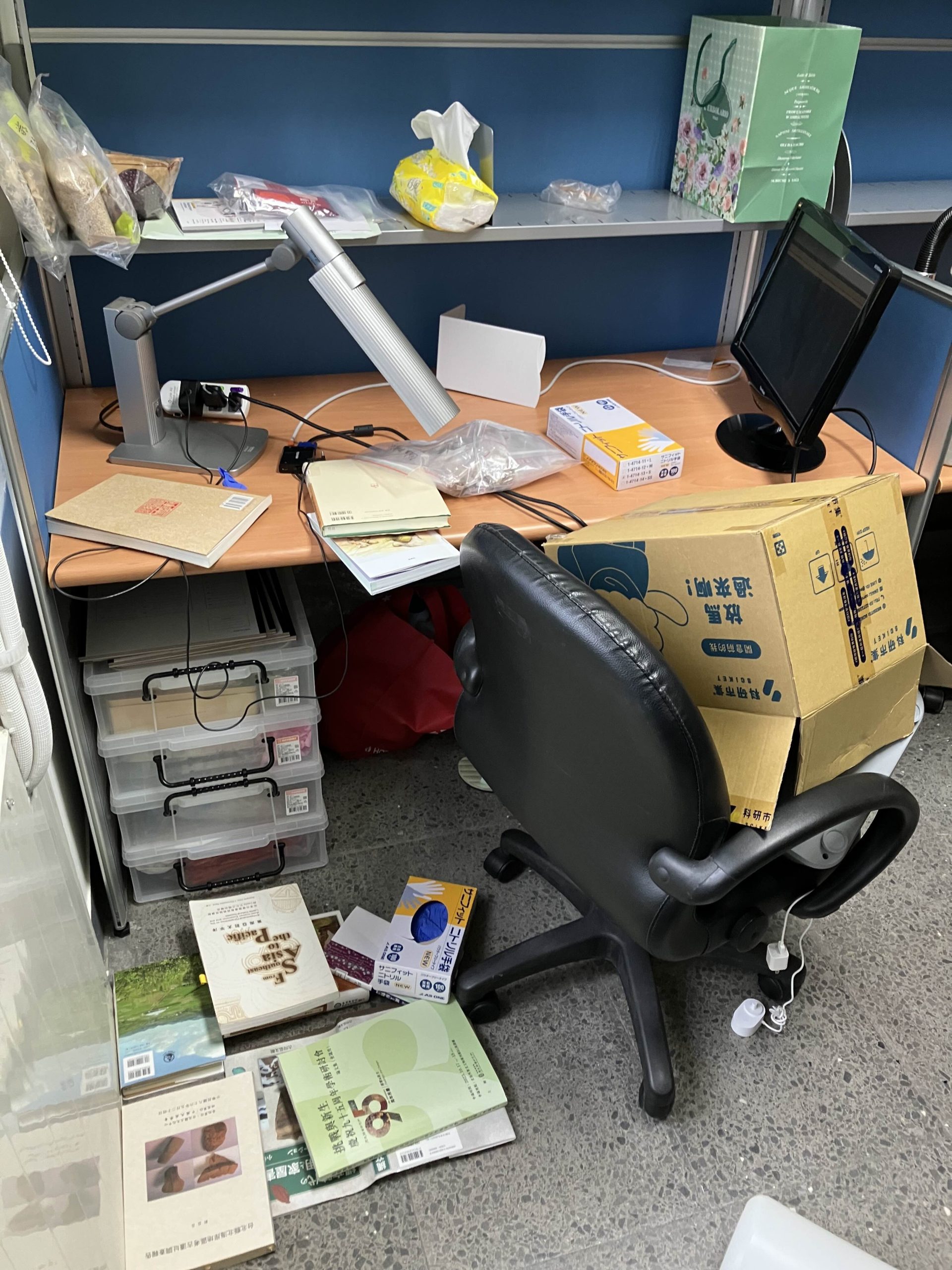
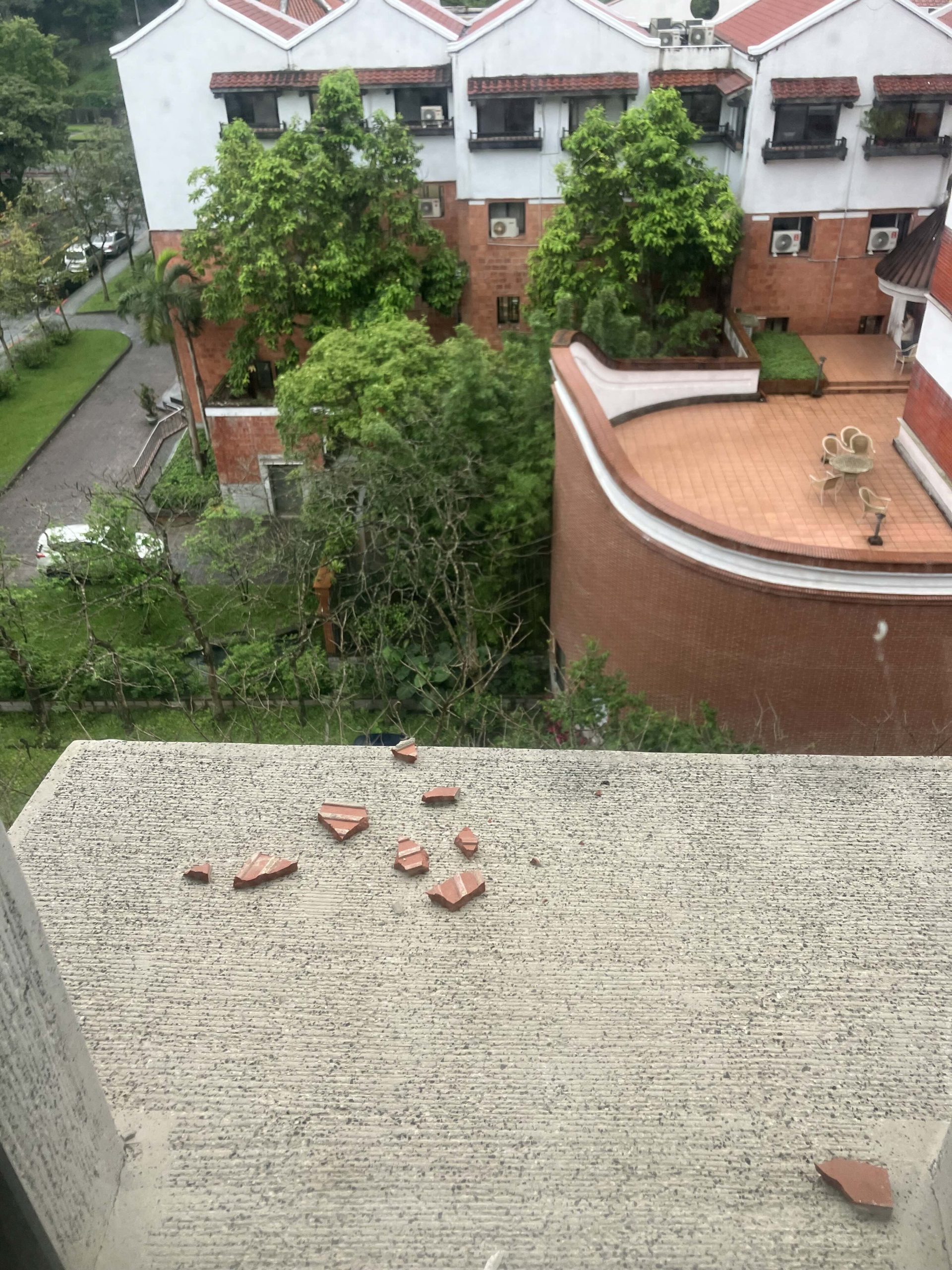
As I wrote earlier, S and I missed the big earthquake that hit Taiwan on April 3. When we returned to our apartment a couple of days later, there was no visible damage. A towel had fallen off a rack and a mop and broom on our balcony had toppled over, and that was it. Things were a bit more disordered in the visiting scholars’ office at the Institute of History and Philology, which is on the sixth floor of an older building. Books and water bottles and desk lamps had fallen off the shelves and desks; the samples that the archaeology PhD student normally keeps neatly filed in a box were scattered in her chair and on the floor. On the ledge outside the window were some broken pieces of a tile that had shaken loose from the outside of the building.
Last week [ed. note: another week has passed since I wrote that], some aftershocks hit that were big enough to shake Taipei. I was surprised to learn that aftershocks could still be happening weeks after the initial quake; I had thought of them as something confined to the hours afterward. The librarians at the Institute had been the ones to alert me to the possibility of ongoing movement over a long period: “Oh, we’ll probably have aftershocks for weeks or months now,” they told me. They were very voluble when I casually asked them what their experience of the earthquake had been–even when there’s no structural damage, a big quake really messes up a library. The shelves wobbled and swayed and books cascaded off of them, making the place both dangerous and disorderly. “If you find any books out of order,” they said, “please understand.”
An aftershock (in Chinese, yúzhèn 餘震, something like “after-shake” or “extra-shake”) is a littler earthquake that originates from the same place as the original one. I have learned that although the general frequency of aftershocks diminishes in a predictable way (there’s even a law that a Japanese seismologist came up with in the 1890s to describe the pattern), individual aftershocks are unpredictable. Once an area goes back to its baseline level of seismic movement—that is, the vibrations aren’t happening any more often than the historical norm for that place—the aftershocks are considered over. So the things we felt last week [ed.: two weeks ago] were aftershocks of the April 3 quake. According to Taiwan’s Central Weather Administration, which monitors these things, to date there have been 1,303 aftershocks from that event. I’ve felt, I think, five.
Everything I say in the rest of this post is going to seem either charmingly or annoyingly naïve to those of you who live in places where earthquakes are frequent. For me, though, this is all quite novel. I think the only other time I experienced an earthquake may have been when I was teaching English in Suzhou in the summer of 1997. It was the end of my time there—I’d finished my short-term gig and my students and friends had gone home, so I was quite alone. In the middle of the night I half woke up to the sensation that my bed was rolling or undulating somehow, like it had turned into a waterbed. It wasn’t unpleasant or particularly alarming, and nothing else seemed to be falling or crashing, so when it subsided I just lay there for a few minutes, listening, and when nothing seemed to be happening I went back to sleep. This was before cell phones and the Internet—okay, not actually, but I certainly didn’t have access to a cell phone or the Internet—and in my solo state there was no easy way to corroborate that what I imagined had happened (an earthquake) had actually happened.
So the recent aftershocks were the first time I knew for sure that I was experiencing the earth sensibly moving. And it’s weird! The first one was on Monday night as I was getting ready to go to bed. It took a second to realize what was happening as the bed and the floor seemed to move left and right. I called out to Sonja in his bedroom next to mine, “Did you feel that?” “Yes!” He called back. After a few minutes of stillness the floor began to vibrate in a direction exactly perpendicular to the first motion—backward and forward. Then it was over.
I realized immediately why people in the past reached for animal metaphors when describing earthquakes. As I learned from my friend Albert’s post about the earthquake, a Taiwanese expression for an earthquake is “the earth buffalo flips over.” It’s hard not to imagine some sort of sentience behind the seemingly random movement of the whole room. That first set of felt aftershocks made me think of a cat playing with a toy, experimentally batting it in one direction before batting it in the other. Suddenly knowing that this thing you’d experienced to be absolutely solid and unchanging can jiggle and slide—well, it’s like that moment in Avatar: The Last Airbender where Avatar Aang discovers that the forested island he’d been swimming around is actually a lion turtle.
