One of my favorite moments in Taiwan so far:
A few weeks ago I was at the new year’s dinner that Academia Sinica’s Institute of History and Philology (IHP) hosts for its employees. The IHP is my host organization for this stay in Taiwan. It is the oldest and one of the larger institutes belonging to Academia Sinica, which is a national research center for all academic disciplines. Academia Sinica was founded on the mainland in 1928, and currently has 24 institutes and 9 research centers in three divisions: Mathematics and Physical Sciences, Life Sciences, and Humanities and Social Sciences. I think it’s fair to say that Academia Sinica is the most prestigious academic institution in Taiwan. Its scholars aren’t expected to teach, though some of them volunteer to teach occasionally at universities, as the spirit moves them, I guess. They spend all of their time pursuing research, hosting scholars from around the world, and presenting at conferences both abroad and in Taiwan. Oh, and dealing with administrative tasks and office politics. No one escapes those, not even the Sinica scholars.
So anyway, once a year the IHP has a big dinner to thank its employees for their hard work—researchers, librarians, archivists, administrative assistants, everybody. And they graciously even include visiting scholars like me. There were over a hundred people there, and as we came in they issued each person a raffle ticket.
We then enjoyed a lovely Chinese banquet that even included alcohol at each table. I had declared myself a vegetarian when I RSVP’d so I was seated at an all-vegetarian table. As is typical of a Chinese-style banquet, we were eating at large circular tables that seated about 10 or 12 people, and that had a glass turntable in the middle. The food went around and around and everyone took what they wanted, and rather than leaving the vegetarians to make a meal as best they could by picking at the vegetable dishes rotating around the meat eaters’ tables, they kindly made a table just for us and served only vegetarian dishes at that table. So we got just as abundant a feast as the meat eaters.
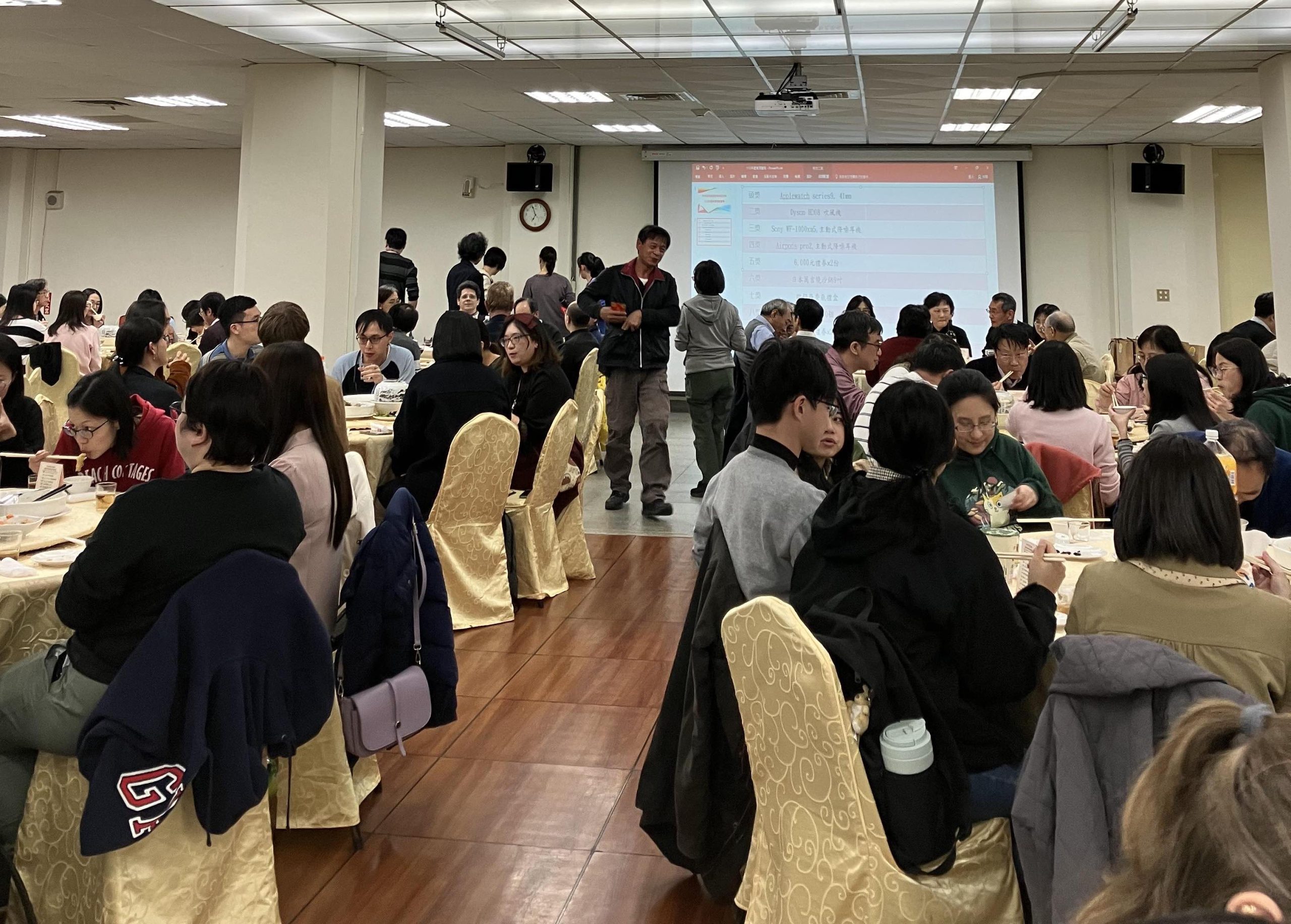
At our table was a Buddhist nun, seated next to me, who is a Ph.D. candidate in history doing research in the Academia Sinica libraries with the support of a host scholar at the IHP. As we ate and chatted, the head and deputy head of the IHP drew the raffle numbers and awarded what seemed like an endless series of prizes (a colleague told me they had enough prizes to give one to 1 out of every 3 people there). They worked their way up from the smallest prizes, gift cards for the equivalent of $5 or so, to the top prizes. #1 was an Apple Watch. #2, the second-to-last prize awarded, was a fancy, top-of-the-line hair dryer.
When introducing second prize, the deputy head said, “This is a useful item for anyone between age 6 and 66. Who will be the lucky winner?” He reached his hand into the bag and pulled out a slip of paper. “Number 72!” He called out, and everyone checked their ticket. The nun next to me started in alarm when she saw her number, and immediately started trying to give it away to someone else at the table. But no one would let her—she’d won the prize fair and square. As she made her way up to the front, laughter spread across the hall. She graciously accepted the prize and endured the laughter (I think it was all good humored, a common recognition of the absurdity of the situation), then brought her fancy hair dryer back to our table. “I’ll give it to my brother,” she said, smiling.
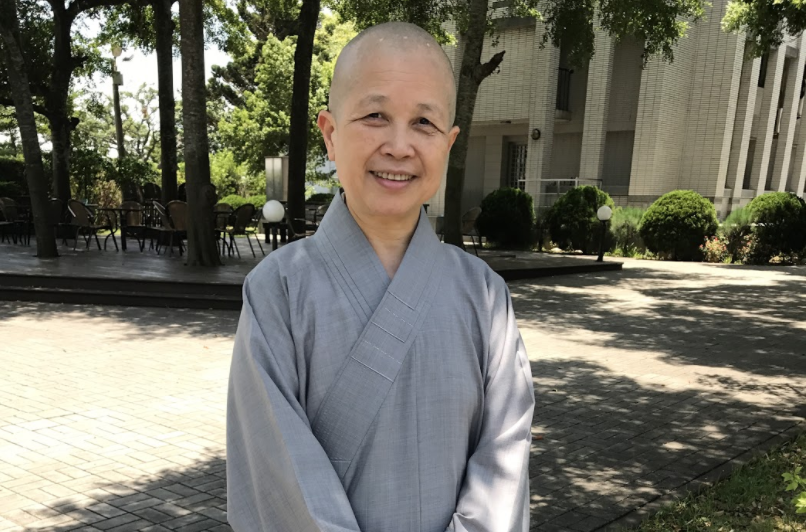
In case you don’t already know why this is funny, this is what a Taiwanese Buddhist nun looks like: